How AI is Transforming Small Business Operations (2026 Playbook)
Small businesses in 2026 aren't just using AI—they are running on it. From autonomous support agents to predictive inventory, discover the complete playbook for transforming your operations with AI.

In this article
How AI is Transforming Small Business Operations (2026 Playbook)
Last Updated: February 7, 2026
The narrative that "AI is coming" is outdated. In 2026, AI is here, it's autonomous, and it is the primary driver of small business growth.
For decades, small businesses fought an uphill battle against corporations with deep pockets and armies of staff. They were outspent on marketing, outmatched in logistics, and outgunned in customer service.
Today, that dynamic has inverted. With the right AI stack, a team of five can outmaneuver a corporation of five hundred.
This isn't about using ChatGPT to write emails or generate generic social media captions. It's about fundamental operational transformation. It's about Agents—autonomous software that doesn't just "assist" but "acts." It's about systems that learn, adapt, and execute 24/7 without requiring a coffee break.
In this comprehensive playbook, we'll break down exactly how AI is rewriting the rules of small business operations, from customer support to supply chain management, and provide a step-by-step roadmap for implementing these changes today.

📌1. The New Customer Experience: 24/7, Human-Like, Instant
The "9-to-5" business hour is extinct. Consumers in 2026 expect instant answers, whether it's 2 PM on a Tuesday or 2 AM on a Sunday. For a small business, staffing 24/7 support used to be financially impossible. Now, it's trivial.
The Rise of the "Service Agent"
Modern AI chatbots have evolved into Service Agents. Unlike the frustrating scripted bots of 2023, these agents understand context, sentiment, and intent. They don't just answer FAQs; they perform actions.
Imagine a customer, Sarah, visits your online store at midnight:
- Sarah: "I want to return the boots I bought last week, but I lost the receipt."
- Old Bot: "Please email support@..." (Transformation Killer)
- 2026 Agent: "No problem, Sarah. I found your order #12345 based on your email. I've generated a QR return code for you. Would you like me to email it to you?"
Capabilities of Modern Service Agents:
- Order Modifications: "Change my shipping address to..." -> Agent validates address via Google Maps API and updates Shopify instantly.
- Returns & Refunds: "I want to return this." -> Agent checks return policy eligibility, generates a shipping label, and processes the refund to store credit.
- Complex Troubleshooting: Agents can guide users through technical setups using vision capabilities—analyzing user-uploaded photos to identify installation errors.
- Upselling: "Is this camera compatible with my lens?" -> Agent confirms compatibility and suggests a bundle deal with a 5% discount.
💡 Pro Tip: Transparency Wins
Don't hide your AI. In 2026, customers prefer an instant answer from a smart agent over waiting 24 hours for a human response. Be transparent, label the agent clearly (e.g., "Support Bot (AI)"), but ensure the agent is capable. If it gets stuck, it should seamlessly hand off to a human with a full conversation transcript.
We've covered this extensively in our guide to AI Customer Service, but the key takeaway is this: Support is no longer a cost center; it's a retention engine. A resolved issue in under 60 seconds turns a frustrated customer into a loyal advocate.
📌2. Marketing: The "One-Person" Agency
Small business owners often wear the "CMO" hat reluctantly. It's time-consuming, expensive, and requires a diverse skillset (copywriting, design, analytics). AI has taken that hat and upgraded it into a supercomputer.
Automated Creative Testing (Generative Loops)
In the past, you'd run one ad and hope it works. If it failed, you lost money and time. Now, tools like Flux, Midjourney, and Runway allow you to generate 100 variations of an ad creative in minutes.
This process is called a Generative Loop:
- Generation: You input your product URL. The AI generates 20 different visual hooks (e.g., "product on a desk," "product in nature," "lifestyle shot").
- Copywriting: AI writes distinct copy angles—emotional ("Feel better"), logical ("Save 20%"), urgent ("Limited time").
- Deployment: Agents upload these variations to Meta/Google Ads.
- Optimization: Agents monitor performance in real-time. They automatically kill the losers (low CTR) and double down on the winners, reallocating budget without you lifting a finger.
For a deep dive into the best tools for this, check out our reviews of Top Video Generators and [AI Writing Tools](/blog/best-ai-writing-tools-2026).
Hyper-Personalization at Scale
AI analyzes your CRM data to send hyper-specific messages. The days of "spray and pray" newsletters are over. Instead of one email to everyone, an AI agent can send 5,000 unique emails simultaneously:
- "Hey Sarah, it's been 30 days since you bought the face cream. Running low? Here's 10% off a refill."
- "Hi Mike, noticed you looked at the winter jackets but didn't buy. Here's a review from someone with your exact build."
- "Hello Jen, happy birthday! Here's a free gift with your next order."
Geo-Targeting and Local SEO
For brick-and-mortar businesses, AI is a game-changer for Local SEO. AI tools can:
- Automatically optimize your Google Business Profile with fresh posts and Q&A.
- Monitor local search trends (e.g., "best coffee near me") and adjust your bidding strategy.
- Translate your content into local languages to capture diverse community segments.
📌3. Operations & Logistics: The "Self-Driving" Supply Chain
This is where the magic happens. Operational friction—stockouts, shipping delays, vendor disputes—is the silent killer of small businesses. AI Agents are the cure, turning a chaotic supply chain into a self-driving ecosystem.
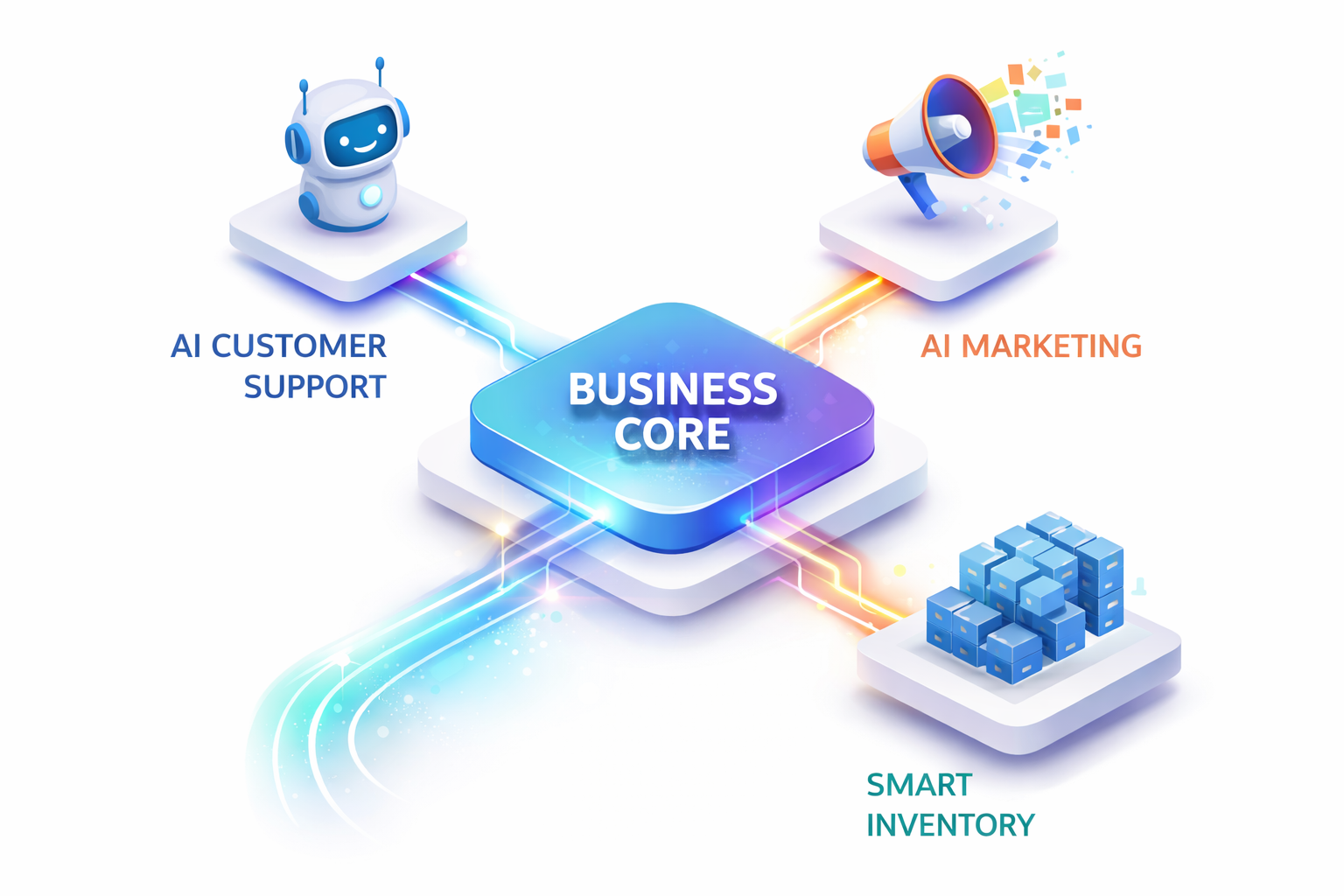
Predictive Inventory Management
Stop guessing how much stock to buy. Overstocking ties up cash; understocking loses sales. AI solves this with Predictive Analytics. AI analyzes vast datasets to predict demand with frightening accuracy:
- Historical Sales Data: "You sold 50 units last February."
- Seasonality Patterns: "Sales dip 15% after Valentine's Day."
- Macro Trends: "A viral TikTok trend is boosting demand for 'eco-friendly' products by 200%."
- Weather Forecasts: "A cold front is coming; expect a spike in heater sales."
The result? The system tells you exactly what to order and when. As we discussed in our Shopify Scaling Blueprint, advanced autonomous agents can even draft the Purchase Order (PO) for you and send it to the supplier for your final approval.
Automated Vendor Operations
Imagine an AI that chases your suppliers for you, so you don't have to.
- Agent: "Hi Supplier X, tracking shows shipment #123 is stuck in customs. Please provide an update."
- Supplier: "It will be cleared tomorrow."
- Agent: "Noted. Updating expected delivery date in our internal dashboard and notifying affected customers."
This level of automation frees you to focus on strategy and relationships, not chasing packages and tracking numbers.
📌4. Finance & HR: The "Invisible" Back Office
Paperwork is the enemy of speed. Administrative tasks drain energy and creativity. AI creates a "Zero-Admin" environment where compliance and finance happen in the background.
Real-Time Financial Intelligence
Tools like Quickbooks Advanced (AI Edition) or Xero's AI features don't just record transactions; they understand them.
- Expense Categorization: 99.9% accuracy in auto-sorting receipts.Snap a photo, and the AI matches it to the bank transaction, categorizes it, and calculates VAT.
- Cash Flow Forecasting: "Warning: Based on current spending and Accounts Receivable, cash flow will be tight in 14 days. Consider delaying the new laptop purchase."
- Tax Prep: Continuous, real-time tax estimation. You're never surprised in April because your "AI Accountant" has been running the numbers daily.
- Invoice Chasing: AI agents can politely but persistently follow up on unpaid invoices, increasing collection rates by up to 40%.
Smarter Hiring and HR
Recruiting for a small business is high-stakes. One bad hire can ruin the culture. AI hiring assistants can de-risk the process:
- Resume Screening: Screen 500 resumes in seconds to find the top 5 matches based on skills, not keywords.
- Initial Interviews: Conduct initial voice-screenings to verify language skills, availability, and salary expectations.
- Onboarding: Create personalized onboarding checklists and answer new hire questions ("Where do I park?", "What's the wifi password?") instantly via Slack.
📌5. The "Tech Stack of 2026": Essential Tools
To implement this, you need the right tools. Here is a recommended "Starter Stack" for a small business in 2026:
| Category | Recommended Tool | Primary Function | Cost (Est.) |
|---|---|---|---|
| Brain / LLM | Claude 3.5 Sonnet / GPT-5 | Strategy, Writing, Coding | $20/mo |
| Support Agent | Tidio (Lyro) or Intercom Fin | 24/7 Customer Service | $50-$100/mo |
| Marketing | Flux + Jasper | Image Gen & Copywriting | $60/mo |
| Automation | Zapier Central or Make | Connecting Apps & Workflows | $30/mo |
| Operations | Shopify Sidekick | E-commerce Mgmt Agent | Included |
| Meeting AI | Fireflies.ai | Transcribes & Summarizes Calls | $20/mo |
Total Estimated Cost: ~$200 - $300 per month. Value: Equivalent to a team of 3 full-time employees.
📌6. Implementation Roadmap: Your First 30 Days
Don't try to do everything at once. Follow this 4-week sprint to transform your business.
Week 1: Audit & Low-Hanging Fruit
- Goal: Identify time sinks.
- Action: Track your time for 5 days. Circle every task that is repetitive and rules-based (e.g., answering "Where is my order?" emails).
- Tech: Sign up for an AI Support Agent (like Tidio) and feed it your FAQ.
Week 2: Marketing Automation
- Goal: Increase output without increasing effort.
- Action: Use AI to generate 1 month of social media content (images + captions). Schedule them using a tool like Buffer or Hootsuite.
- Tech: Midjourney for images, ChatGPT/Claude for captions.
Week 3: Operational Connectivity
- Goal: Connect your apps.
- Action: Set up Zaps (Zapier) to automate data flow. Example: New Shopify Order -> Add to Google Sheet -> Add logic to "Thank You" email list.
- Tech: Zapier or Make.com.
Week 4: Review & Refine
- Goal: Optimization.
- Action: Review the performance of your Support Agent and Marketing posts. seamless intervention points where the AI failed.
- Tech: Analytics dashboards.
📌7. The "Human-in-the-Loop" Philosophy
With all this automation, where do humans fit in? This is the most common fear.
The Shift: Humans move from Operators to Conductors.
- Old Way: You spend 4 hours answering emails.
- New Way: You spend 15 minutes reviewing the AI's "Drafted Replies" and 3 hours building strategic partnerships.
Old Way: You manually update a spreadsheet. New Way: You analyze the dashboard the AI created to make a strategic pivot.
The businesses that thrive in 2026 are those that use AI to enhance their humanity, not remove it. They use the time saved to have longer calls with VIP clients, to design better products, and to build better cultures.
❓FAQ: Operations AI
Q: Is AI expensive for small businesses?
A: No. As shown in the "Tech Stack" section, the cost of a robust "AI Stack" (e.g., $200-$300/month) is a fraction of the cost of a single human employee. The ROI is usually immediate given the time saved.
Q: What about data privacy?
A: In 2026, enterprise-grade privacy is available for small businesses. Ensure you use tools offering "Zero-Retention" policies for sensitive data. Never put sensitive customer PII (Personally Identifiable Information) into public LLMs without encryption or enterprise agreements.
Q: Will I lose control of my business?
A: No. You maintain control by setting up "Guardrails." Start with "Co-Pilot" mode where the AI suggests an action, and you must click "Approve." Once you trust the system's accuracy, you can switch to "Auto-Pilot" for specific, routine tasks.
Q: Do I need to know how to code?
A: Absolutely not. The "No-Code" revolution means most AI agents are set up using natural language. If you can write an email explaining what you want, you can program an agent in 2026.
⚖️Conclusion: Adapt or Obsolesce
The gap between "AI-Native" small businesses and traditional ones is widening every day. The former operate with the efficiency of a Fortune 500 company and the agility of a startup. The latter are drowning in admin work and slow response times.
The transformation doesn't happen overnight. It starts with a mindset shift. It starts with looking at every repetitive task and asking, "Could an agent do this?"
Start with one friction point—maybe it's your overflowing inbox, or your chaotic inventory, or your inconsistent social media. Apply an AI agent there. Win that time back. Then move to the next.
The future of small business isn't about working harder. It's about building a machine that works for you.
Tools Mentioned in This Article
Zapier
FreemiumAutomate your workflow
ChatGPT
FreemiumThe AI That Started It All (2026 Edition)
Claude
FreemiumThe ChatGPT Killer? (Anthropic's Best AI)
Jasper
PaidAI Writing for Marketers (But At What Cost?)
Flux
FreemiumNext-gen image generation
Runway
FreemiumEverything you need to make anything
AI Fuel Hub Editorial Team
A collective of AI researchers, engineers, and product experts dedicated to testing and reviewing AI tools. Combined 50+ years of experience in artificial intelligence.