AI vs Traditional Antivirus: Which Protects Better? (2026 Guide)
Wondering if your old antivirus is enough? Dive into our comprehensive AI vs Traditional Antivirus comparison to see how machine learning blocks zero-day threats before they strike.

In this article
I still remember the days when keeping your computer safe meant buying a boxed CD-ROM from the local electronics store once a year, installing it, and hoping for the best. Back then, if your system didn’t immediately start acting like it had ingested a digital flu, you considered yourself protected.
But let’s be brutally honest: times have changed, and the bad guys have gotten significantly smarter.
If you are relying on the exact same security approach from a decade ago, you are practically leaving your front door wide open. Today, we are seeing a massive shift in how cybersecurity software operates. The buzzword on everyone’s lips? Artificial Intelligence.
But is it just marketing fluff, or does machine learning actually make a difference? In this AI vs Traditional Antivirus comparison, we are going to break down exactly how both systems work, where they fail, and which one actually protects you better in 2026.
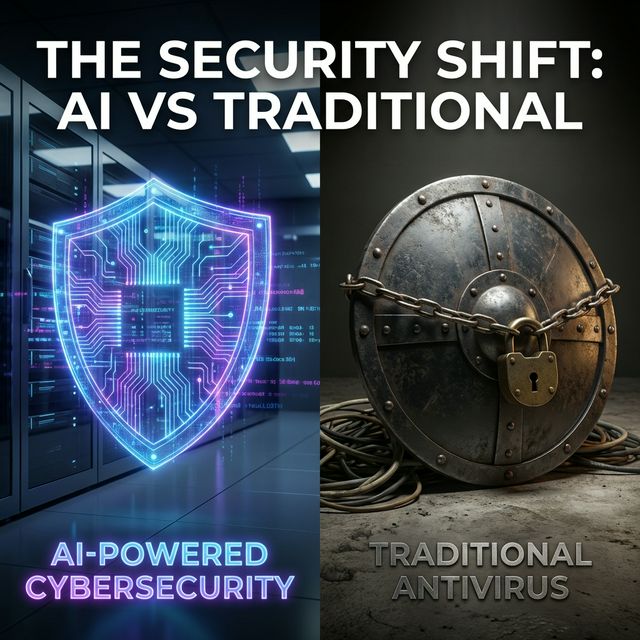
📖The "Old Guard": How Traditional Antivirus Works
To understand the hype around AI security, we first have to understand the old way of doing things.
Traditional antivirus (AV) software operates primarily on what’s known as signature-based detection. Think of it like a bouncer at a club holding a thick binder full of "Wanted" posters.
When a piece of software tries to enter your computer, the traditional AV checks its code against a massive database of known malware signatures. If the code matches a "Wanted" poster, the file is blocked, quarantined, or deleted.
Where Traditional AV Shines
- Predictability: If a threat is known, old-school AV will absolutely catch it.
- Low False Positives: Because it relies on exact matches, it rarely blocks legitimate software (unless a software developer accidentally reused some sketchy code).
- Simplicity: For average home users dealing with legacy threats, it provides a solid baseline of security.
The Fatal Flaw of the "Wanted" Poster
Here is the catch: what happens if a criminal puts on a disguise? Or worse, what happens if it’s a completely new criminal who isn’t in the bouncer’s binder yet?
This is called a zero-day threat—malware that has literally just been created and released into the wild. Traditional antivirus is practically blind to zero-day attacks. According to recent reports by authoritative sources like CISA, hackers use automated tools to alter malware code slightly every few hours, instantly rendering signature databases obsolete.
Waiting for your AV company to update their database, push the update to your computer, and run a scan is a losing game. By the time the poster is printed, the bad guys are already inside your network.
📌Enter the AI Era: Behavioral Analysis & Machine Learning
This is where things get interesting. Instead of relying on a static list of known bad guys, AI-powered antivirus looks at behavior.
Imagine our bouncer again. But instead of just checking faces against a book, this bouncer has a degree in psychology and watches how people act. If someone walks in, completely ignores the music, pulls out a crowbar, and starts prying open the cash register—the bouncer tackles them. It doesn’t matter if he has never seen the guy before; the behavior is malicious.
How AI Antivirus Works
AI cybersecurity tools, often categorized under Endpoint Detection and Response (EDR) or Next-Gen Antivirus (NGAV), use machine learning algorithms trained on billions of data points.
They monitor your system in real-time, looking for anomalies:
- Is a word processor suddenly trying to heavily encrypt all your documents? (Classic ransomware behavior).
- Is an unknown app trying to access your webcam or microphone in the background?
- Is your computer suddenly trying to send gigabytes of data to an unknown server at 3 AM?

AI doesn't care what the file is named or what its signature looks like. If it acts like malware, the AI shuts it down instantly.
For businesses, especially those in Tier 1 data markets like the US, UK, Canada, and Australia looking for robust data compliance, this behavioral approach is non-negotiable. It provides a massive leap in proactive defense.
📖The Ultimate Showdown: AI vs Traditional Antivirus Comparison
Let's put them head-to-head in the metrics that actually matter.
1. Stopping Power (Zero-Day Threats)
Winner: AI Antivirus As we discussed, traditional AV is reactionary. AI is proactive. In a world where ransomware can lock up a company’s entire network in minutes, you cannot afford to wait for a database update. AI neutralizes threats before they have a known name.
2. System Performance
Winner: AI Antivirus (Usually) Remember when starting an antivirus scan meant you couldn't use your computer for two hours? Traditional AV relies on heavy, scheduled scans of your entire hard drive, constantly cross-referencing giant databases. AI operates more like a lightweight security camera. It monitors active processes rather than scanning dormant files, resulting in significantly less CPU drag and battery drain.
3. False Positives
Winner: Traditional Antivirus This is the one area where the old guard still holds its own. Because AI is looking for "suspicious behavior," it can sometimes get jumpy. If you are a developer compiling custom code, or if you use niche, highly specialized software, an aggressive AI might occasionally flag it as a threat. However, the machine learning models are getting much better at contextualizing behavior to reduce these false alarms.
4. Setup and Maintenance
Tie Traditional AV requires constant, sometimes annoying, database updates. AI solutions are generally cloud-managed and update their algorithmic models seamlessly in the background. However, enterprise-level AI setups require some tuning to ensure they understand what "normal" looks like for your specific network.
📌Should You Ditch Your Old Antivirus?
The short answer? Yes.
If you are running a business, managing sensitive client data, or just want absolute peace of mind, traditional signature-based antivirus simply doesn't cut it anymore. The threat landscape has evolved, and your defenses need to evolve with it.
You don't necessarily have to uninstall Windows Defender (which actually incorporates a lot of cloud-based AI these days), but supplementing your security stack with a dedicated, AI-driven EDR solution is the smartest tech investment you can make this year. Check out some of our top-rated solutions in the Cybersecurity Tools category on our platform to find the right fit for your needs.
❓Frequently Asked Questions (FAQ)
Is AI antivirus harder to install than traditional antivirus?
Not at all! For individual users and small businesses, modern AI antivirus software installs just as easily as traditional software. The complex machine learning computations happen in the cloud, so the software on your device remains lightweight and easy to manage.
Can AI completely stop ransomware?
While no security solution is 100% foolproof, AI is currently the most effective defense against ransomware. Because ransomware exhibits highly specific behavior (mass file encryption), AI can detect and terminate the process within milliseconds, often before any significant damage is done.
Does AI antivirus invade my privacy by monitoring my behavior?
AI security focuses on the behavior of software and processes, not your personal habits. It monitors system calls, file modifications, and network requests, ensuring your privacy while keeping the machine secure from unauthorized intrusions.
Author's Note: Maintaining a secure digital footprint is critical. Always ensure your software is up to date and never rely entirely on a single point of failure. Explore more AI tools for your business on AI Fuel Hub.
AI Fuel Hub Editorial Team
A collective of AI researchers, engineers, and product experts dedicated to testing and reviewing AI tools. Combined 50+ years of experience in artificial intelligence.