Cloud Security Solutions Powered by AI (2026 Guide)
Explore the top AI-powered cloud security solutions for 2026. Discover how CNAPP, CSPM, and AI threat detection are protecting enterprise cloud environments from advanced cyberattacks.

In this article
Cloud Security Solutions Powered by AI (2026 Guide)
Last Updated: February 21, 2026
As enterprises continue to migrate massive operational workloads to the cloud, the attack surface has expanded exponentially. Traditional perimeter defenses are no longer sufficient to protect distributed, multi-cloud environments. The sheer volume of configurations, identities, and microservices makes manual monitoring impossible. Enter Cloud Security AI.
Artificial Intelligence (AI) and Machine Learning (ML) have become the cornerstone of modern cloud security. By automating threat detection, continuously monitoring posture, and correlating vast amounts of telemetry data, AI-powered solutions provide the visibility and automated response capabilities necessary to defend against sophisticated, cloud-native attacks.
This comprehensive guide explores the critical role of AI in cloud security, breaks down the core technologies like CNAPP and CSPM, reviews the top enterprise strategies for securing your multi-cloud infrastructure, and dives deep into practical case studies demonstrating the ROI of an AI-first approach in 2026.
📌The Cloud Security Challenge: Why Human Effort is Not Enough
The Complexity of Multi-Cloud Environments
Modern enterprises rarely rely on a single cloud provider. A mix of AWS (Amazon Web Services), Microsoft Azure, and Google Cloud Platform (GCP) is the norm today. This multi-cloud architecture brings unparalleled agility, avoiding vendor lock-in and allowing engineering teams to pick the best-of-breed services from each provider. However, it introduces immense complexity. Each platform has its own IAM (Identity and Access Management) model, configuration settings, native security tools, and terminology.
For security operations teams, this creates a fragmented landscape characterized by several overwhelming challenges:
- Configuration Drift: A simple misconfiguration (e.g., leaving an AWS S3 bucket public or exposing a database port to the internet in Azure) is the leading cause of cloud data breaches. Tracking these configurations across thousands of dynamic, ephemeral assets is completely beyond human scale.
- Identity Sprawl and Machine Identities: The number of machine identities (service accounts, API keys, IAM roles) far outnumbers human identities by a ratio of roughly 10-to-1. Managing the lifecycle of these machine identities, many of which are significantly over-permissioned by developers moving fast, creates massive blind spots.
- Alert Fatigue: Native cloud monitoring tools generate thousands of alerts daily. When an engineer enables AWS GuardDuty, Azure Security Center, and GCP Command Center simultaneously, the resulting noise floor overwhelms SOC (Security Operations Center) analysts, leading to critical threats being ignored or missed entirely.
- The Ephemeral Nature of Cloud Compute: Containers and serverless functions (like AWS Lambda) may only exist for a few seconds or minutes. By the time a traditional security scanner identifies a vulnerability or an attack in progress on a specific pod, the pod may have already been spun down and replaced.
How AI Transforms Cloud Defense
AI bridges the critical gap between the speed of cloud deployment and the speed of security. It allows defenders to operate at the speed of algorithms, rather than the speed of human analysts.
- Predictive Analysis and Baseline Generation: Instead of waiting for a known attack signature or static IOC (Indicator of Compromise) to trigger an alert, AI algorithms establish a dynamic baseline of normal behavior for every user, workload, and API in your cloud ecosystem. Any deviation (anomaly)—whether it is a developer accessing a database at 3 AM or an EC2 instance suddenly communicating with a known crypto-mining pool—triggers a real-time investigation.
- Automated Contextualization: When a security alert fires, AI instantly correlates it with hundreds of other seemingly unrelated events. For example, it might connect a brute-force login attempt against an identity provider with a subsequent API call to modify a cloud security group, followed by the deployment of a new EC2 image. The AI groups these events into a single, high-priority "Incident" timeline, rather than presenting them as isolated alerts. This dramatically reduces the Mean Time to Understand (MTTU).
- Self-Healing Infrastructure: Advanced AI solutions do not just send a Slack notification; they take autonomous action. If an AI agent detects an unauthorized change to an IAM policy that violates compliance, it can automatically revert the change to the secure baseline within milliseconds, preventing human error from culminating in a devastating breach.
📌Core Technologies: The AI Cloud Security Stack
To understand the rapidly evolving cloud security market, one must demystify the acronyms. Over the last few years, the industry has aggressively consolidated siloed point solutions into unified platforms powered by centralized AI engines.
1. Cloud-Native Application Protection Platform (CNAPP)
A CNAPP is the holy grail of modern enterprise cloud security. It brings together multiple security disciplines into a single platform, providing end-to-end visibility from the developer's workstation (code creation) to runtime execution in production. AI is the vital engine that drives this unification, seamlessly correlating software vulnerabilities found in pre-deployment code (like hardcoded secrets or outdated dependencies) with active cyber threats detected in the live runtime environment. By bridging the Dev and SecOps divide, CNAPP allows organizations to prioritize remediation based on actual runtime exposure.
2. Cloud Security Posture Management (CSPM)
CSPM tools continuously monitor cloud environments against compliance frameworks and security best practices to identify misconfigurations. Traditional CSPM generated massive spreadsheets of failures. AI has revolutionized CSPM by prioritizing risks contextually. Instead of blindly listing 10,000 misconfigurations of equal severity, an AI-driven CSPM generates a topological graph of the cloud environment. It analyzes "attack paths" and identifies the 5 critical misconfigurations that an attacker could actually exploit right now to reach sensitive customer data, ignoring the thousands of low-level risks that lack a viable attack vector.
3. Cloud Infrastructure Entitlement Management (CIEM)
In the cloud, identity is the new, definitive perimeter. CIEM focuses solely on managing identities and access privileges. AI models analyze the delta between the permissions granted to an identity and the permissions actually used over a 30-day or 90-day window. If a service account possesses sweeping administrative rights but historically only makes "read" API calls to a single S3 bucket, the AI will recommend (or automatically apply) a dramatically tightened least-privilege policy, drastically reducing the blast radius of a potential credential theft.
4. Cloud Workload Protection Platform (CWPP)
CWPP is designed to protect the actual runtime workloads—whether they are traditional Virtual Machines (VMs), containerized orchestration clusters (like Kubernetes), or ephemeral serverless functions. AI agents deployed via DaemonSets or sidecars continuously monitor the behavioral execution of these workloads at runtime, halting zero-day exploits, unauthorized lateral movement, and fileless malware before they can successfully detonate or exfiltrate data.
5. Application Security Posture Management (ASPM)
A newer entrant closely related to CNAPP, ASPM provides a comprehensive view of application security tools (SAST, DAST, SCA) and correlates their findings. AI helps in ASPM by deduplicating findings from multiple scanners and filtering out false positives, ensuring that developers only see actionable, accurate vulnerabilities that must be fixed prior to deployment.
🏆Top AI-Powered Cloud Security Strategies for Enterprises in 2026
Implementing AI cloud security requires a paradigm shift in strategic approach. Forward-thinking CISOs and cloud security architects consider these best practices mandatory:
The "Shift-Left" AI Integration Strategy
Security can no longer be an archaic afterthought applied by a separate team just before deployment. "Shift-left" means shifting security responsibilities earlier in the Software Development Life Cycle (SDLC) by integrating it deeply into the CI/CD pipeline.
- AI Code Scanning in the IDE: Provide developers with AI-assisted security feedback in their Integrated Development Environments (IDEs) using tools like GitHub Copilot or Tabnine. These tools can scan code as it is being typed, flagging insecure encryption methods, SQL injection risks, and suggesting secure coding alternatives in real-time.
- Infrastructure as Code (IaC) Validation: Implement AI tools to scan IaC templates (Terraform, CloudFormation, Pulumi) for misconfigurations before the infrastructure is physically provisioned in the cloud. If an engineer attempts to merge a pull request that deploys a publicly accessible database, the CI/CD pipeline will automatically block the deployment and the AI will suggest the necessary remediation code.
Adopting Zero Trust Cloud Architecture
Zero Trust fundamentally assumes that threats exist both outside and inside the network. The philosophy is simple: Never trust, always verify, and continuously authorize.
- Continuous AI Authentication: Traditional single sign-on (SSO) is no longer adequate. AI must continuously analyze user and entity behavior (UEBA), looking at parameters such as typing cadence, geographical location, travel velocity, and typical resource access times. If a previously authenticated engineering manager suddenly begins downloading gigabytes of proprietary source code from an unusual IP address at midnight, the AI instantly revokes access and demands step-up biometric authentication or manager approval.
- Dynamic Microsegmentation: AI-driven tools map complex application dependencies and create granular network policies on the fly. This ensures that if one specific Docker container is compromised by a vulnerability, the attacker is structurally prevented from moving laterally to other critical databases or microservices on the same network subnet.
Unified Visibility Across Hybrid and Multi-Cloud
Siloed security tools create blind spots that attackers exploit. In 2026, enterprise security mandates solutions that offer a true single pane of glass across AWS, Azure, GCP, and on-premises environments.
- Security Data Lake Analytics: Centralize raw telemetry logs from all distinct cloud providers into a massive, AI-powered security data lake. This unified architecture allows sophisticated machine learning models to identify slow, low-intensity, cross-cloud attack campaigns that would remain entirely invisible to native, platform-specific monitoring tools operating in isolation.
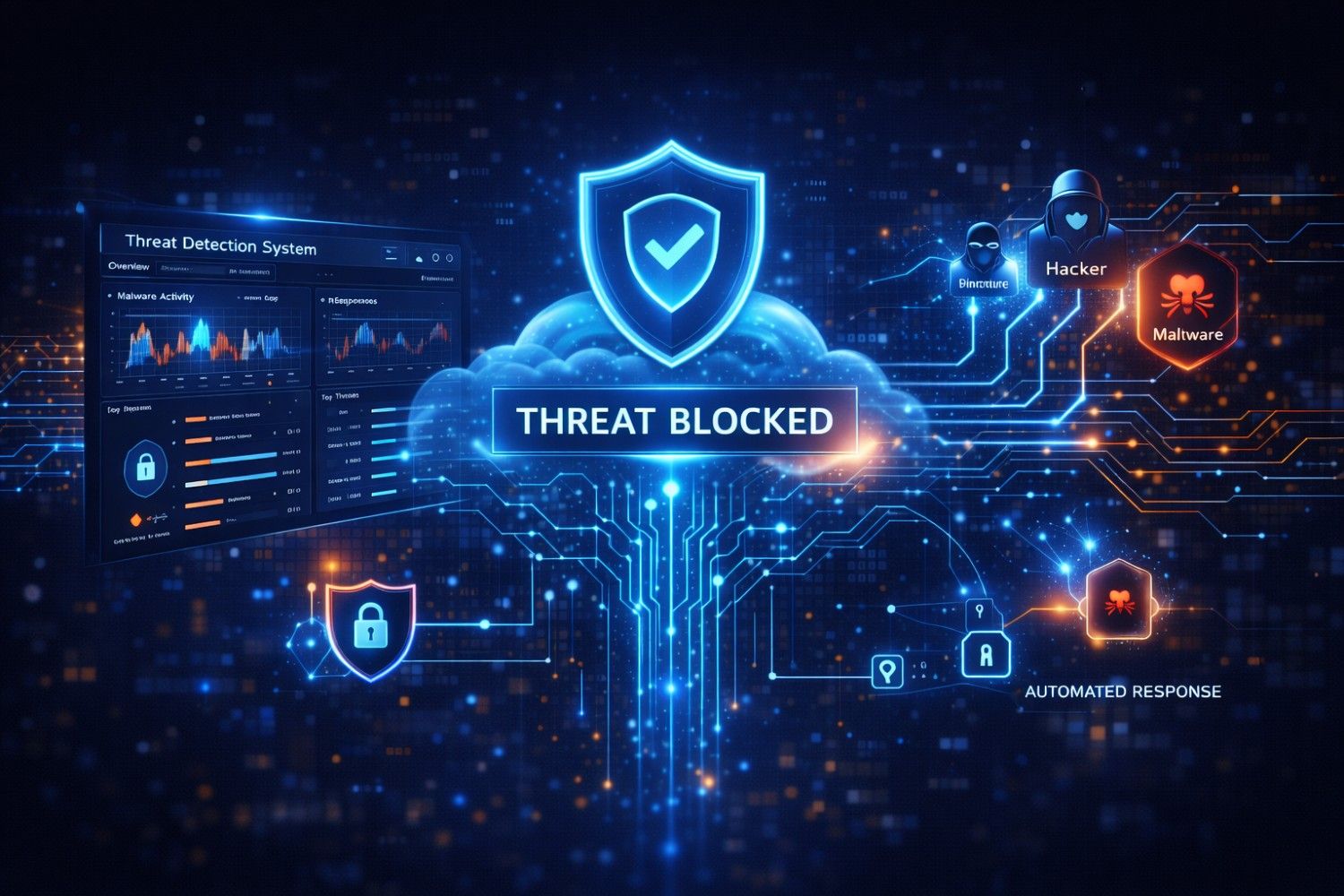
AI-driven threat detection correlates events across the entire cloud infrastructure in real-time, mapping lateral movement and stopping breaches autonomously.
📌ROI In-Depth: Real-World Business Value of Cloud Security AI
For CFOs, Boards of Directors, and CISOs, a heavy investment in modern AI cloud security platforms must be rigorously justified. The Return on Investment (ROI) is realized rapidly through a combination of extreme risk reduction, operational efficiency, and business enablement.
- Drastic Reduction in Remediation Costs (The 1-10-100 Rule): According to industry research, fixing a critical vulnerability during the coding phase costs around $10. Fixing it during the QA testing phase costs $100. Fixing it after deployment in a live production environment can cost over $1,000—not including downtime. AI-driven shift-left tools drastically reduce these ballooning late-stage fixes by catching errors early in the SDLC.
- Unleashing SOC Efficiency (The Ultimate Force Multiplier): AI effortlessly handles tens of thousands of routine, low-fidelity alerts, automatically closing false positives. This allows the human security team to focus exclusively on highly strategic threat hunting, incident response architecture, and custom detection engineering. This operational efficiency drastically reduces the desperate need to constantly hire expensive, hard-to-find Tier 1 security analysts amidst an ongoing global cybersecurity talent shortage.
- Achieving Continuous Compliance Automation: Achieving and maintaining certifications like SOC2 Type II, ISO 27001, HIPAA, or PCI-DSS in a dynamic cloud environment is notoriously difficult and labor-intensive. AI continuously maps your cloud footprint against these regulatory controls and automates complex evidence collection. What used to be a grueling, stressful month-long manual audit is transformed into a streamlined, automated reporting process that provides instant proof of compliance to enterprise clients.
- Preventing Catastrophe (The Breach Avoidance Metric): The ultimate ROI, though difficult to measure precisely, is the devastating breach that did not happen. An automated AI response mechanism that instantly locks down an S3 bucket exfiltration incident saves the company an average of $4.5 million in forensic costs, devastating regulatory fines, lost intellectual property, plummeting share price, and long-term reputational damage.
Case Study: Financial Services Enterprise
Consider a global fintech company managing $50 billion in assets across AWS and Azure. Their SOC team of 15 analysts was drowning in 5,000 AWS GuardDuty and Azure Security Center alerts daily. They struggled with a 3-week backlog for simple alert triage.
They deployed a leading AI-driven CNAPP solution. Within 30 days, the AI engine learned their typical deployment patterns and API usage. It automatically clustered the 5,000 daily alerts into just 15 actionable, high-priority "Incidents," prioritizing them by actual risk and exposure. The AI completely automated the resolution of 80% of routine IAM misconfigurations.
The Result: The SOC team's Mean Time to Respond (MTTR) dropped from 7 days to 14 minutes. They avoided hiring 5 additional analysts, saving $750k annually, and successfully passed a grueling SOC2 audit with zero exceptions because the AI continuously enforced compliance policies across their 40,000 cloud assets.
📌Advanced Deep Dive: Leading Cloud Security AI Tools to Watch
While we do not exclusively endorse a single vendor, understanding the leading platforms helps architects visualize what AI is currently capable of in the enterprise space:
- Wiz (CNAPP Pioneer): Wiz revolutionized the industry by focusing on agentless scanning. It connects to cloud environments via APIs, rapidly building an AI-driven topological graph of the entire infrastructure. It excels at identifying toxic combinations—for example, a server that is both externally facing, contains a critical unpatched CVE, and has an overly permissive IAM role attached to it.
- Palo Alto Networks Prisma Cloud: A comprehensive, heavy-hitting enterprise platform that integrates heavily with their existing firewall technology. Prisma Cloud uses sophisticated machine learning models to provide deep runtime protection, Web Application and API Security (WAAS), and stellar CI/CD pipeline integration.
- CrowdStrike Falcon Cloud Security: Leveraging its massive, globally distributed threat graph, CrowdStrike brings its world-renowned endpoint AI expertise directly to cloud workloads. It is exceptionally strong at stopping active adversaries and zero-day runtime threats using a unified, lightweight agent.
- SentinelOne Singularity Cloud: Known for autonomous, AI-driven remediation, SentinelOne protects cloud workloads by focusing on behavioral AI. Its ability to instantly roll back malicious changes offers an unparalleled safety net against ransomware attacks targeting cloud servers.
📌The Future: Generative AI as the Ultimate Security Co-Pilot
While predictive AI and machine learning have been around for years, the next massive frontier is the direct integration of generative AI (Large Language Models like ChatGPT, Claude, and specialized security models) directly into security operations.
- Socratic Natural Language Queries: Instead of struggling with complex query languages (like PromQL or KQL), analysts will simply ask their security console in plain English, "Show me all active AWS EC2 instances that are vulnerable to the latest Log4j CVE and are directly exposed to the internet." The GenAI will instantly parse the intent, translate it into the specific database query, execute it, and return the precise answer.
- Instant Automated Threat Summaries: Instead of forcing an analyst to manually read through hundreds of raw CloudTrail JSON logs, GenAI will provide a concise, plain-English summary of an attack's entire lifecycle. It will clearly explain how the threat actor gained initial access via a compromised developer token, how they moved laterally to a specific database, and precisely which customer records were accessed.
- Custom Autoremediation Policy Generation: Cloud administrators can describe a required security posture in natural language, such as "Generate an AWS IAM policy that grants read-only access to this specific S3 bucket, but restrict it so that access is only allowed from our corporate VPN IP range during business hours." The AI will instantly generate the perfect, error-free JSON policy required to enforce it, eliminating the risk of syntax errors leading to security holes.
⚖️Conclusion: The Absolute Necessity of Algorithmic Defense
Securing the modern cloud in 2026 is an intense, high-stakes battle of AI-vs-AI. Sophisticated threat actors are aggressively leveraging heavy automation and generative machine learning models to continuously scan for vulnerabilities, craft undetectable spear-phishing campaigns, and launch complex, multi-stage attacks at unprecedented speeds.
To defend against algorithmic, machine-speed attacks, human intervention alone is mathematically impossible. You need an algorithmic defense.
By enthusiastically embracing unified CNAPP platforms, strictly enforcing dynamic Zero Trust architectures, and heavily leaning on AI for proactive continuous monitoring and lightning-fast automated response, large enterprises can confidently achieve the incredible agility of the cloud without constantly compromising their security posture. The time for manual, legacy cloud security is permanently over. The era of autonomous, AI-driven defense is here, and it is reshaping everything.
External Resources for Further Reading and Framework Compliance
For deeper tactical dives into detailed technical implementations, regulatory compliance mapping, and architectural framework guidelines, consider these indispensable industry resources:
- Cloud Security Alliance (CSA) - Global industry best practices, deep research papers, and essential cloud control matrixes.
- MITRE ATT&CK for Cloud - A comprehensive, continuously updated knowledge base of specific cloud adversary tactics, techniques, and procedures (TTPs).
- AWS Well-Architected Framework: Security Pillar - Foundational guidelines and prescriptive advice for building highly secure scale architectures directly on AWS infrastructure.
- The Center for Internet Security (CIS) Benchmarks - The absolute gold standard for baseline configuration checklists for cloud providers.
Explore Related AI Efficiency Tools
If you want to read more about how AI and automation tools are radically transforming other areas of modern business operations, explore our comprehensive AI Tools Directory. Discover in-depth reviews and comparisons of industry-leading solutions like ChatGPT for Business, Claude by Anthropic, and code-generation lifesavers like GitHub Copilot.