Endpoint Security with AI: Best Solutions for Enterprise (2026 Guide)
Explore the top AI-powered endpoint security solutions for 2026. Learn how artificial intelligence is revolutionizing enterprise defense against ransomware, zero-day threats, and sophisticated cyberattacks.

In this article
Endpoint Security with AI: Best Solutions for Enterprise (2026 Guide)
Last Updated: February 14, 2026
In the rapidly evolving landscape of cybersecurity, traditional defenses are falling short. The era of static, signature-based antivirus is over. Today, enterprises face a deluge of sophisticated threats—from polymorphic ransomware and fileless malware to AI-generated phishing campaigns and automated botnet attacks. To combat these advanced adversaries, organizations must adopt Endpoint Security with AI.
Artificial Intelligence (AI) and Machine Learning (ML) have transformed endpoint protection from a reactive game of "whack-a-mole" into a proactive, predictive defense system. By analyzing vast datasets of behavioral patterns, AI can identify and neutralize threats before they execute, even if they have never been seen before.
This comprehensive guide explores the critical role of AI in modern endpoint security, reviews the top 5 enterprise solutions for 2026, and provides a strategic roadmap for implementation. Whether you are a CISO, IT Director, or Security Architect, this article will equip you with the knowledge to make informed decisions for your organization's security posture.
📌The Evolution of Endpoint Security: Why AI is Mandatory
The Limitations of Legacy Antivirus
For decades, endpoint protection relied on signatures. Security vendors would identify a virus, extract a unique string of code (a signature), and push an update to client devices. If a file on your computer matched that signature, it was blocked.
This approach fails against modern threats for several reasons:
- Polymorphic Malware: Attackers use automated tools to slightly alter the code of a virus every time it is deployed. A single piece of malware can generate millions of unique hashes, rendering signature-based detection useless.
- Fileless Attacks: Malicious code executes directly in the computer's memory (RAM) without writing any files to the disk. Legacy AV tools that only scan files are blind to these attacks.
- Zero-Day Exploits: Vulnerabilities in software that are unknown to the vendor. Since there is no patch and no signature, traditional tools offer zero protection.
The AI Advantage: Behavioral Analysis
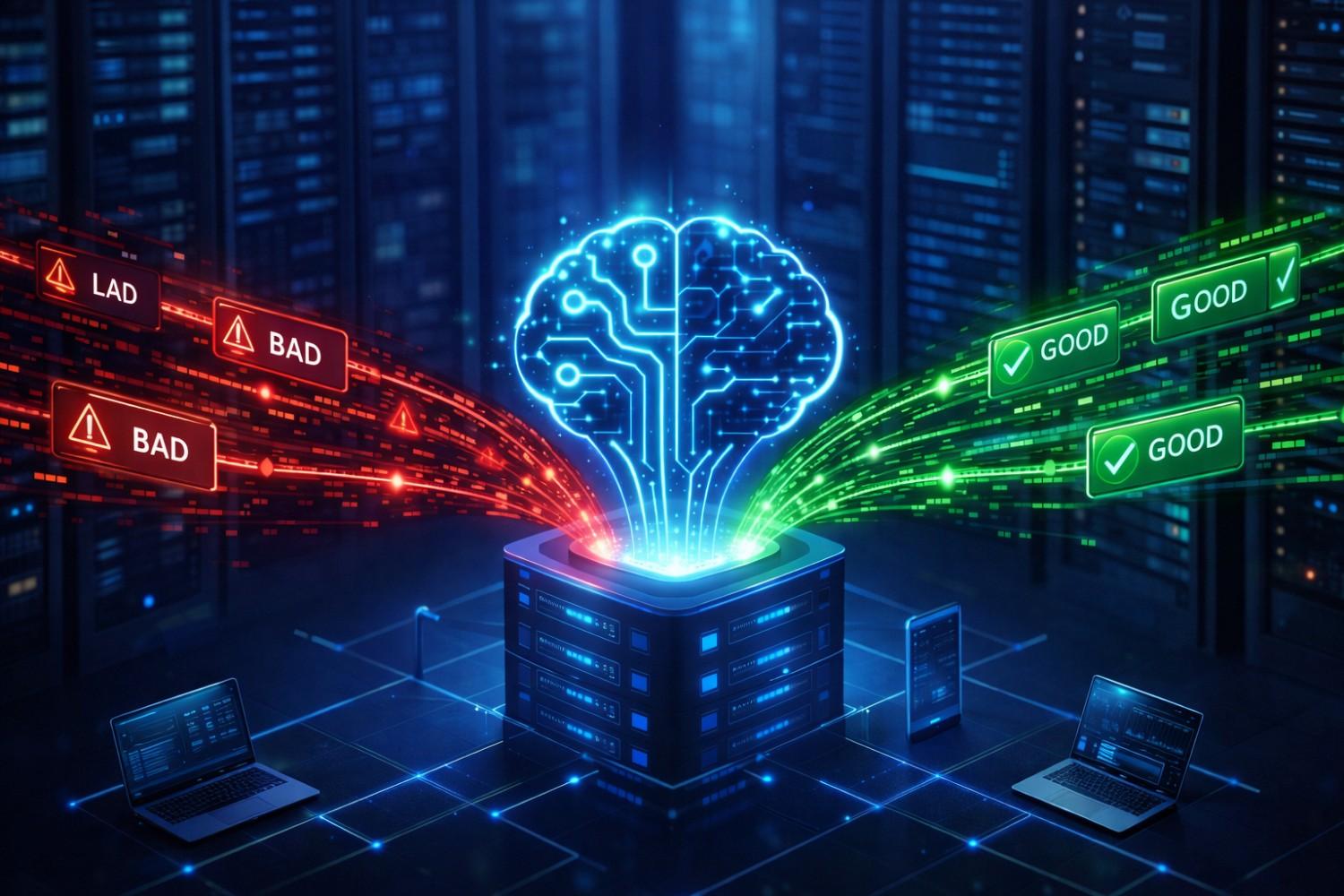
AI endpoint security shifts the focus from "what the file looks like" to "what the file does." Machine learning algorithms are trained on petabytes of good and bad file data to establish a baseline of normal behavior.
When an unknown file attempts to execute, the AI analyzes its behavior in real-time:
- Is it trying to encrypt a large number of files rapidly? (Ransomware behavior)
- Is it attempting to inject code into a critical system process like svchost.exe? (Code injection)
- Is it trying to establish a connection to a known command-and-control server? (Botnet activity)
If the behavior is malicious, the AI blocks the process and rolls back any changes, regardless of whether it has a signature for that specific file.
Key Cybersecurity Statistics for 2026
- 93% of malware seen in 2025 was polymorphic, meaning it had a unique hash.
- 68% of breaches involved non-malware attacks (e.g., credential theft, living-off-the-land binaries).
- The global average cost of a data breach has risen to $4.8 million, with healthcare and finance sectors seeing even higher costs.
- Enterprises using AI security automation experienced a $1.76 million lower cost per breach compared to those without.
🏆Top 5 AI Endpoint Security Solutions for Enterprise (2026)
We have evaluated the leading market solutions based on detection rates, false positive ratios, ease of management, AI maturity, and total cost of ownership.
1. SentinelOne Singularity Platform
SentinelOne is widely regarded as the pioneer of autonomous AI endpoint security. Its "Singularity" platform is built on the premise that security should happen on the endpoint itself, without reliance on cloud connectivity.
AI & Key Features
- Static AI: Prevents attacks pre-execution by analyzing file headers and characteristics.
- Behavioral AI: Monitors running processes for malicious actions in real-time.
- ActiveEDR & Storyline™: Perhaps its most powerful feature, Storyline automatically correlates disparate events (processes, registry changes, network connections) into a single, easy-to-read timeline. This massively reduces the "mean time to investigate" (MTTI) for analysts.
- One-Click Rollback: If a threat does execute (e.g., ransomware), SentinelOne can instantly reverse all changes, restoring files to their pre-infection state.
Pros & Cons
| Pros | Cons |
|---|---|
| Complete Autonomy: Full protection even when offline. | Cost: Can be expensive for smaller enterprises. |
| Ease of Use: Storyline feature simplifies complex investigations. | Resource Usage: Agent can be heavier on older hardware compared to cloud-only tools. |
| High Efficacy: consistently scores top marks in MITRE ATT&CK evaluations. |
Best For: Enterprises needing high-fidelity threat visibility and autonomous remediation capabilities.
2. CrowdStrike Falcon
CrowdStrike revolutionized the industry with its cloud-native architecture. The Falcon platform leverages a single lightweight agent that streams telemetry to the CrowdStrike Threat Graph in the cloud.
AI & Key Features
- Threat Graph: Analyzes trillions of events per week from millions of sensors globally, allowing CrowdStrike to detect sophisticated attacks by correlating data across its entire customer base.
- IOA (Indicators of Attack): Focuses on detecting the intent and behavior of an attacker, rather than just looking for known IOCs (Indicators of Compromise).
- Charlotte AI: A generative AI security analyst that allows users to ask natural language questions about their environment, such as "What assets are vulnerable to Log4j?"
- Falcon OverWatch: A managed threat hunting service where human experts use AI tools to proactively hunt for threats in your environment.
Pros & Cons
| Pros | Cons |
|---|---|
| Lightweight Agent: Minimal impact on system performance. | Cloud Dependency: Full feature set requires internet connectivity. |
| Threat Intelligence: Unmatched global intelligence network. | Cost: Modular pricing can become very expensive. |
| Scalability: Easily scales to hundreds of thousands of endpoints. |
Best For: Large organizations that prioritize scalability and integration with top-tier threat intelligence.
3. Microsoft Defender for Endpoint
Microsoft has transformed Defender from a basic consumer antivirus into a powerhouse enterprise security platform. It benefits from the immense telemetry of the Windows ecosystem.
AI & Key Features
- Cloud-Delivered Protection: Uses massive cloud ML models to analyze suspicious files instantly.
- Automated Investigation and Remediation (AIR): AI agents mimic the steps of a human analyst to investigate alerts and take remediation actions automatically. Microsoft claims this resolves up to 80% of routine alerts.
- Copilot for Security: Deep integration with GPT-4 allows analysts to generate incident summaries, reverse engineer scripts, and get step-by-step remediation guidance.
- Seamless Integration: Native integration with Windows, Office 365, and Azure Active Directory (Entra ID).
Pros & Cons
| Pros | Cons |
|---|---|
| Integration: Unbeatable if you are a Microsoft shop. | Complexity: Configuration can be complex (Intune/SCCM). |
| Cost Effective: Often included in E5/E3 licenses. | Non-Windows Support: improving, but still best on Windows. |
| Automation: excellent automated remediation capabilities. |
Best For: Organizations already deeply invested in the Microsoft 365 ecosystem.
4. Sophos Intercept X
Sophos distinguishes itself with its use of "Deep Learning," a more advanced form of machine learning that mimics the human brain's neural networks.
AI & Key Features
- Deep Learning Neural Network: Trained on hundreds of millions of samples to detect known and unknown malware with high accuracy and low false positives.
- CryptoGuard: A specialized anti-ransomware layer that detects malicious encryption behaviors and automatically rolls back affected files.
- Adaptive Attack Protection: The system dynamically adjusts its aggression level. If it detects an active attack, it heightens defenses to block even suspicious (but usually benign) activities until the threat is neutralized.
Pros & Cons
| Pros | Cons |
|---|---|
| Ransomware Protection: Best-in-class CryptoGuard technology. | Reporting: Reporting features can be less granular than competitors. |
| Simplicity: Easy to manage for mid-sized IT teams. | Support: Tier 1 support can sometimes be slow. |
| Integration: Great integration with Sophos Firewalls (Synchronized Security). |
Best For: Mid-market to Enterprise organizations focused on preventing ransomware.
5. Palo Alto Networks Cortex XDR
Cortex XDR was the industry's first "XDR" solution, breaking down silos by integrating endpoint, network, and cloud data into a single analysis engine.
AI & Key Features
- Behavioral Analytics (UEBA): AI profiles user and device behavior to detect anomalies, such as a user logging in from an unusual location or accessing sensitive data at odd hours.
- Incident Grouping: AI automatically groups related alerts into "Incidents," drastically reducing alert fatigue for SOC analysts.
- Root Cause Analysis: Automatically identifies the root cause of an alert (e.g., the phishing email that started the attack) to speed up investigation and response.
Pros & Cons
| Pros | Cons |
|---|---|
| Network Visibility: Unmatched integration with network firewalls. | Complexity: Steep learning curve for the interface. |
| Detection Quality: High-fidelity alerts with low noise. | Cost: Premium pricing for a premium product. |
Best For: Organizations that want a unified platform for both network and endpoint security.
📌ROI of AI Endpoint Security: Is it Worth the Investment?
Implementation of advanced AI/ML security tools often comes with a higher price tag than legacy AV. However, the Return on Investment (ROI) is compelling when considering the Cost of Inaction.
- Reduced Breach Risk: The average breach costs $4.8 million. Preventing just one major incident pays for decades of endpoint security licensing.
- Operational Efficiency: AI tools with automated remediation (like SentinelOne and Microsoft Defender) can reduce the time analysts spend on routine alerts by 50-80%. This allows you to run a leaner, more efficient SOC.
- Compliance: Regulations like GDPR, CCPA, and HIPAA require "reasonable security measures." Using state-of-the-art AI defenses is a strong defensible position in the event of an audit or incident.
- Business Continuity: Ransomware can shut down operations for weeks. AI tools with rollback capabilities ensure that even if an infection occurs, business operations can resume in minutes, not days.
🎯Implementing Your Strategy: A 5-Step Roadmap
Adopting AI endpoint security is a journey, not a destination. Follow this roadmap for a successful deployment:
- Assessment & Discovery: Audit your environment. You cannot protect what you cannot see. Identify all endpoints, including unmanaged devices, IoT, and BYOD.
- Proof of Concept (PoC): Don't rely on marketing sheets. Select 2-3 vendors and run a 30-day PoC. Test them against real-world scenarios (use a Red Team if possible) to see how they detect and respond.
- Deployment & Tuning: Start with "Audit Mode" to learn the baseline behavior of your environment without blocking legitimate business processes. Tune the AI to reduce false positives before switching to "Block/Protect Mode."
- Integration: Don't let your endpoint security live in a vacuum. Integrate it with your SIEM, SOAR, and ticketing systems (ServiceNow, Jira) to streamline workflows.
- Continuous Training: AI provides the intelligence, but humans provide the wisdom. Train your SOC analysts on how to interpret the AI's findings and how to "feed" the system with feedback to improve its accuracy.
📌Future Trends: The War of Algorithms
As defenders adopt AI, so do attackers. We are entering an era of Adversarial AI, where cybercriminals use machine learning to defeat machine learning.
- Deepfakes & Social Engineering: Attackers are using AI to generate convincing voice and video deepfakes of CEOs and executives to trick employees into authorizing fraudulent transfers.
- AI-Fuzzing: Attackers use AI to "fuzz" software (inputting massive amounts of random data) to find zero-day vulnerabilities faster than human researchers.
- Automated Spear Phishing: LLMs (Large Language Models) can generate highly personalized, grammatically perfect phishing emails at scale, bypassing traditional email filters.
In this arms race, the only defense is a security platform that learns and adapts faster than the adversary.
⚖️Conclusion
Endpoint security with AI is no longer a luxury feature for the Fortune 500—it is the baseline requirement for any organization that values its data. The "best" solution depends on your specific needs:
- Choose SentinelOne for autonomy and ease of use.
- Choose CrowdStrike for intelligence and scalability.
- Choose Microsoft Defender for ecosystem integration.
By investing in AI-driven defense today, you are future-proofing your organization against the threats of tomorrow.
Frequently Asked Questions (FAQ)
Q: What is the difference between EDR and XDR? A: EDR (Endpoint Detection and Response) focuses solely on the endpoint (laptops, servers). XDR (Extended Detection and Response) integrates data from endpoints, networks, cloud, email, and identity systems to give a comprehensive, 360-degree view of threats.
Q: Can AI replace human security analysts? A: No. AI is a "force multiplier," not a replacement. It handles the massive volume of data processing and routine triage (Tier 1 work), allowing human analysts to focus on complex investigation, strategy, and policy (Tier 2/3 work).
Q: Is AI endpoint security expensive? A: While the upfront licensing cost is often higher than legacy AV, the Total Cost of Ownership (TCO) is consistently lower. AI reduces the labor cost of manual investigations, re-imaging infected machines, and crucially, prevents the catastrophic costs associated with data breaches.
Q: Does AI security work offline? A: It depends on the vendor. SentinelOne is famous for running its full AI models locally on the agent, offering complete protection offline. CrowdStrike relies more on the cloud for its heavy lifting, though it still has offline prevention capabilities. Always verify the offline efficacy of any solution you choose.
Q: What is the best AI security for small businesses? A: For SMBs, we recommend SentinelOne (via MSSPs) for enterprise-grade protection, Microsoft Defender for Business for those on Microsoft 365, or Bitdefender GravityZone for a balance of performance and cost.