The Future of AI in 2026: 10 Trends That Will Change Business
From Agentic AI to Sovereign Models, we explore the 10 most critical artificial intelligence trends defining 2026 and how they will reshape the business landscape.

In this article
<QuickAnswer question="What are the biggest AI trends in 2026?" answer="The 10 dominant AI trends in 2026 include multimodal AI models that understand text, images, and video simultaneously; AI agents for workflow automation; personalized AI tutors revolutionizing education; AI-powered medical diagnostics; comprehensive AI regulation frameworks; edge AI devices processing data locally; generative AI for creative professionals; enterprise-wide AI adoption; and ethical AI development focusing on bias reduction and transparency." />
The Future of AI in 2026: 10 Trends That Will Change Business
Last Updated: January 2026
The pace of artificial intelligence innovation isn't just accelerating; it's warping the very fabric of how we do business. If 2024 was the year of "wow" (ChatGPT, Midjourney) and 2025 was the year of integration, 2026 is the year of autonomy.
We are moving past chatbots that answer questions to agents that do work. We are seeing nations build their own "Sovereign AI" to protect their culture and data. And we are witnessing the first truly AI-generated blockbusters in Hollywood.
Based on market research, patent filings, and the trajectory of major labs like OpenAI, Google DeepMind, and Anthropic, here are the 10 AI trends that will define 2026.
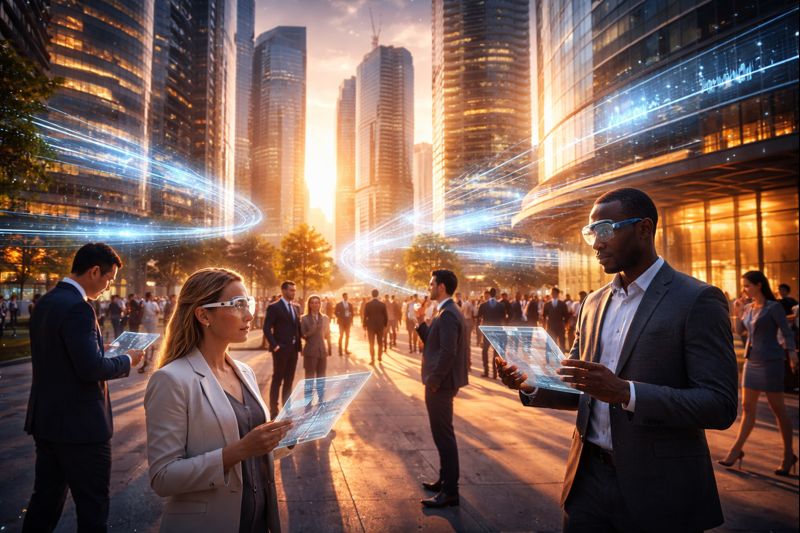
📌1. Agentic AI: The Rise of the "Digital Employee"
The most significant shift in 2026 is the move from Generative AI (creating text/images) to Agentic AI (taking action).
Until now, you had to prompt a conceptual model: "Write an email to John." In 2026, you give an objective: "Plan a marketing campaign for product X, coordinate with the design team for assets, and schedule the launch email."
Agentic AI systems can:
- Reason through complex problems.
- Browse the web and use software tools.
- Remember context over weeks or months.
- Collaborate with other AI agents.
Business Impact: We will see the first one-person unicorns (startups with $1B valuation) run almost entirely by a founder and a fleet of AI agents.
📌2. Sovereign AI: The New Space Race
Nations are realizing that relying on American (OpenAI, Google) or Chinese (Baidu) models is a national security risk.
Sovereign AI refers to government-backed initiatives to build domestic AI models using local infrastructure, data, and talent. France (Mistral), India (BharatGPT), Japan, and the UAE are already heavily investing here.
💡"Data is the new oil, and AI models are the refineries. No nation wants to ship its crude oil abroad to be refined and sold back at a premium."
Key Driver: The desire to preserve language, culture, and control over critical infrastructure.
📌3. "Hollywood 2.0": The First AI-Generated Blockbusters

In 2026, we will see the release of the first feature-length films where >50% of the visual content is AI-generated.
Tools like OpenAI's Sora 2, Runway Gen-4, and Kling 2.0 have reached a level of consistency and fidelity that makes them indistinguishable from reality.
- Cost Reduction: Use of expensive VFX teams will be reserved for only the biggest budget moments.
- Virtual Actors: Background extras and even main characters (licensed from deceased actors or entirely synthetic) will become commonplace.
The Controversy: This trend will continue to fuel labor disputes, but the economic efficiency is too high for studios to ignore.
📌4. Small Language Models (SLMs) on Edge Devices
Not everything needs a massive model like GPT-5. The trend in 2026 is efficiency.
Small Language Models (SLMs) like Microsoft's Phi-4, Google's Gemma, and Apple's on-device models are small enough to run locally on your phone or laptop.
- Privacy: Your data never leaves your device.
- Speed: Zero latency response.
- Cost: No cloud API fees.
Expect your iPhone 17 and Samsung S26 to have built-in AI that monitors your health, organizes your life, and edits your photos without ever connecting to the internet.
📌5. The "Dead Internet" & Authentication
With billions of AI-generated articles, images, and comments flooding the web, finding human content is becoming a premium service.
2026 Trends:
- Certified Human: Platforms will introduce "Proof of Humanity" verifications (like Worldcoin or government ID integration).
- Content Watermarking: Invisible watermarks (like C2PA) will be mandatory for commercial AI content in standard jurisdictions (EU, US).
- Community Gardens: A resurgence of gated communities (Discords, Slack groups, paid newsletters) where AI bots are strictly banned.
📌6. Hyper-Personalized Marketing at Scale
"Dear [First Name]" is dead.
Marketing in 2026 creates entire landing pages, video ads, and email copy on the fly for each individual visitor.
- Dynamic Video: An AI avatar in an ad might speak your language, reference your specific city, and address your company's specific pain points.
- Predictive Shopping: Retailers will ship products before you order them, based on predictive AI models (with free returns if they guess wrong).
📌7. AI in Healthcare: From Diagnosis to Drug Discovery
We are seeing the first FDA-approved drugs in 2026 that were completely discovered and designed by AI.
DeepMind's AlphaFold 4 has mapped the structure of nearly all known proteins, allowing pharma companies to simulate drug interactions in seconds rather than years.
- Personalized Medicine: AI analyzing your genome to prescribe the exact dosage and type of medication you need.
- AI Radiologists: AI systems are now statistically significantly better at detecting early-stage cancers in X-rays and MRIs than human doctors.
📌8. The Rise of "Cobots" in the Physical Workplace
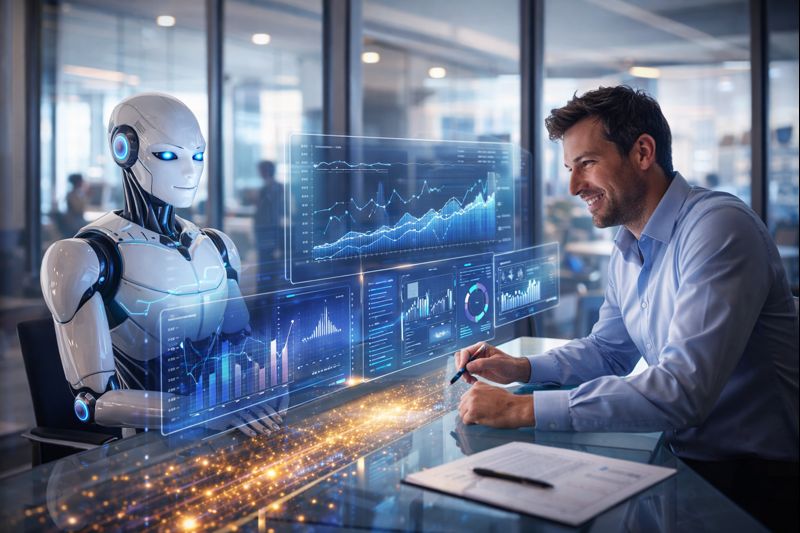
AI is leaving the screen and entering the physical world.
Cobots (Collaborative Robots) are designed to work alongside humans safely.
- Warehouses: Figure 02 and Tesla Bot Optimus are beginning real deployments in logistics centers.
- Hospitality: AI waiters and cleaners are becoming common in high-tech hubs like Tokyo and San Francisco.
- Construction: Bricklaying and welding robots are addressing chronic labor shortages.
📌9. AI Governance & Regulation Maturation
The "Wild West" era is ending. The EU AI Act is fully enforceable in 2026, and the US has rolled out sector-specific regulations.
- Liability: Who is responsible if an AI agent makes a bad trade or crashes a car? 2026 will see the first major Supreme Court precedents set.
- Copyright: "Fair Use" debates for training data will likely reach a settlement, possibly involving a "Spotify for Data" royalty model where artists are paid when their work trains a model.
📌10. The Knowledge Collapse?
A worrying trend for 2026: Model Collapse.
As AI models are trained on more AI-generated data (because the web is full of it), they risk becoming inbred and less intelligent.
- The Value of Human Data: "Clean", verified human-generated data (books, pre-2022 internet archives, private proprietary datasets) will become the world's most valuable asset class.
- Data Licensing: Companies like Reddit, Twitter/X, and NYT will charge billions for access to their human conversations.
⚖️Conclusion: Adapt or Obsolete
The "Future of AI in 2026" isn't about new chatbots; it's about integration and autonomy. The businesses that thrive will be those that don't just "use AI tools" but redesign their entire workflows around AI agents.
What should you do today?
- Audit your workflows: Where can "Agentic AI" take over entire processes, not just tasks?
- Protect your data: Your proprietary data is your only moat. Don't feed it to public models.
- Invest in human connection: As digital content becomes infinite and cheap, authentic human connection becomes scarce and expensive.
The future is bright, but it moves fast. Don't blink.
❓Frequently Asked Questions
What is the biggest AI trend in 2026? ▼
The shift to Agentic AI. AI systems that can independently execute multi-step tasks (like booking travel or coding a website) without constant human prompting.
Will AI replace jobs in 2026? ▼
AI will likely replace tasks rather than entire jobs, but roles in data entry, basic support, and content generation will shrink. Conversely, roles in "AI Orchestration" and "Human-Centric Services" will grow.
What is Sovereign AI? ▼
Sovereign AI refers to nations building their own state-backed AI models and infrastructure to ensure they aren't dependent on foreign technology for critical systems.
Tools Mentioned in This Article
AI Fuel Hub Editorial Team
A collective of AI researchers, engineers, and product experts dedicated to testing and reviewing AI tools. Combined 50+ years of experience in artificial intelligence.