SOC 2 Compliance Tools with AI: Complete Vendor Guide
Compare the best AI-powered SOC 2 compliance tools for 2026. In-depth vendor guide covering Vanta, Drata, Secureframe, Sprinto, and more—with pricing, features, automation capabilities, and expert recommendations for US, UK, and Canadian businesses.

In this article
SOC 2 Compliance Tools with AI: Complete Vendor Guide
Last Updated: February 16, 2026
Getting SOC 2 certified used to mean months of spreadsheet wrangling, six-figure consulting fees, and an audit process that made your entire engineering team want to quit. In 2026, that era is decisively over.
AI-powered SOC 2 compliance tools now automate up to 90% of the evidence collection, continuous monitoring, and audit preparation process—slashing time-to-compliance from 12 months to as little as 4 weeks. For SaaS companies, fintech startups, healthcare platforms, and enterprise vendors operating in the United States, United Kingdom, Canada, Australia, and Germany, SOC 2 certification is no longer optional. It is a revenue gate.
According to AICPA, demand for SOC 2 reports has grown by over 50% since 2023. Meanwhile, Gartner projects the governance, risk, and compliance (GRC) market will reach $21.7 billion by 2027, with AI-driven automation as the primary growth catalyst.
This guide cuts through the vendor noise. We've evaluated 10 leading SOC 2 compliance AI platforms, compared their features, pricing, and automation depth, and built a decision framework so you can pick the right tool for your organization—whether you're a 20-person startup or a 5,000-employee enterprise.
📌What Is SOC 2 Compliance (and Why Does It Matter)?
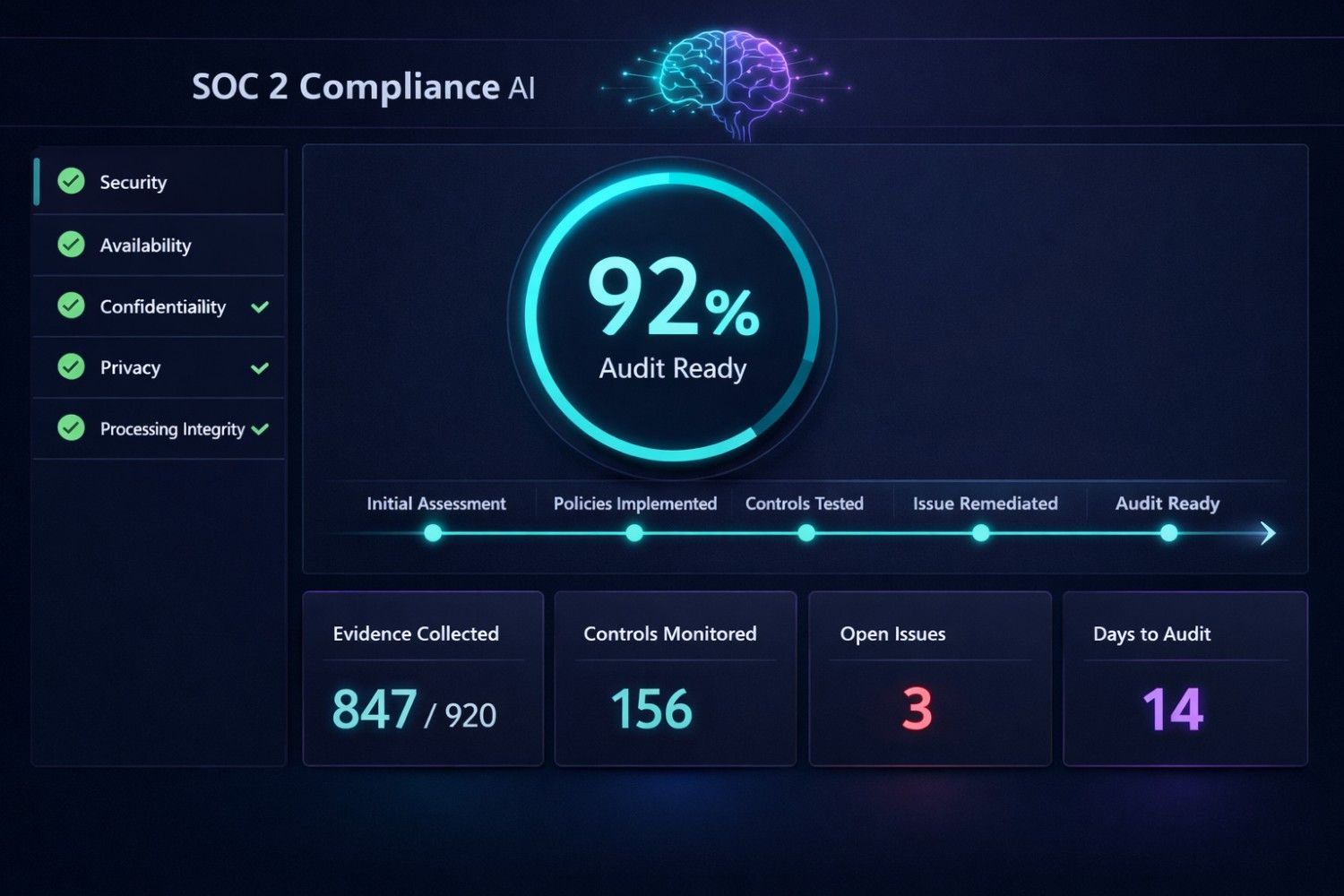
SOC 2 (System and Organization Controls 2) is a security framework developed by the American Institute of Certified Public Accountants (AICPA). It defines how companies should manage customer data based on five Trust Service Criteria (TSC):
| Trust Service Criteria | What It Covers |
|---|---|
| Security | Protection against unauthorized access (firewalls, MFA, encryption) |
| Availability | System uptime, disaster recovery, fault tolerance |
| Processing Integrity | Data accuracy, completeness, and valid processing |
| Confidentiality | Encryption, access controls, data classification |
| Privacy | PII handling, consent management, data retention |
SOC 2 Type I vs. Type II
- Type I evaluates the design of your controls at a single point in time.
- Type II evaluates the operating effectiveness of those controls over a period (typically 3–12 months).
Most enterprise buyers, partners, and regulated industries require Type II reports. This is where AI tools make the biggest difference—continuously monitoring control effectiveness instead of relying on manual screenshots and periodic checks.
💡Key stat: Companies that use AI-powered compliance platforms complete SOC 2 Type II audits 67% faster than those relying on manual processes, according to a 2025 Coalfire benchmark study.
📖How AI Transforms SOC 2 Compliance
Traditional SOC 2 compliance is painful because it's fundamentally a data collection problem. You need to prove—with evidence—that your security controls are designed correctly and operating effectively. That means pulling logs from AWS, screenshots from HR systems, configs from GitHub, and policies from Google Drive, then organizing hundreds of pieces of evidence into a format your auditor can review.
SOC 2 compliance AI tools solve this by:
1. Automated Evidence Collection
AI agents connect directly to your cloud infrastructure (AWS, Azure, GCP), identity providers (Okta, Azure AD), version control (GitHub), HR systems, and endpoint managers. They automatically pull, timestamp, and categorize evidence—24/7, without human intervention.
2. Continuous Control Monitoring
Instead of quarterly manual reviews, AI monitors your controls in real-time. If a developer disables MFA on a production server, you get an instant alert—not a finding in your next audit.
3. AI-Powered Risk Assessment
Machine learning models analyze your infrastructure configuration, access patterns, and policy gaps to generate a risk score and prioritize remediation actions. This is far more accurate than spreadsheet-based risk registers.
4. Intelligent Gap Analysis
AI tools compare your current security posture against SOC 2 requirements and generate a remediation roadmap. Some platforms like Vanta and Drata even auto-generate policy templates using AI language models to fill documentation gaps.
5. Audit-Ready Reporting
When your auditor arrives, the platform generates a structured evidence package—organized by Trust Service Criteria, cross-referenced with controls, and formatted for the audit firm's review. What used to take weeks of preparation now takes hours.
🏆10 Best AI-Powered SOC 2 Compliance Tools (2026)
We evaluated each platform across seven dimensions: AI automation depth, integration count, time-to-compliance, pricing, enterprise readiness, customer support, and auditor network.
1. Vanta
Best for: Fast-growing SaaS startups and mid-market companies
Vanta is the market leader in automated compliance, trusted by over 7,000 companies. Its AI engine connects to 300+ integrations and continuously monitors your infrastructure against SOC 2, ISO 27001, HIPAA, PCI DSS, and GDPR requirements simultaneously.
- AI Features: Automated evidence collection, continuous monitoring, AI-powered policy generation, risk scoring
- Integrations: 300+ (AWS, Azure, GCP, Okta, GitHub, Jira, Slack, HR platforms)
- Time to SOC 2: 2–6 weeks (Type I), 3–6 months (Type II)
- Pricing: Starting at $10,000/year for startups; $25,000–$50,000+/year for enterprise
- Pros: Largest integration library, strong auditor network, excellent onboarding
- Cons: Premium pricing, complex UI for non-technical teams
2. Drata
Best for: Companies needing multi-framework compliance
Drata's AI-powered platform supports 16+ frameworks out of the box, making it ideal for companies that need SOC 2 + ISO 27001 + HIPAA simultaneously. Its Trust Management Platform uses machine learning to map controls across frameworks automatically.
- AI Features: Cross-framework control mapping, automated evidence collection, real-time monitoring, AI risk insights
- Integrations: 200+ native integrations plus custom API
- Time to SOC 2: 3–8 weeks (Type I)
- Pricing: Starting at $10,000/year; custom enterprise pricing
- Pros: Multi-framework mapping saves tremendous manual work, sleek UI, strong automation
- Cons: Some advanced features require higher-tier plans
3. Secureframe
Best for: Developer-first teams and engineering-heavy organizations
Secureframe differentiates with its developer-friendly approach. Its AI Comply™ feature uses large language models to auto-complete security questionnaires, generate policies, and write remediation scripts. If your team lives in the terminal, Secureframe is your compliance platform.
- AI Features: AI Comply™ for questionnaire automation, policy generation, auto-remediation workflows
- Integrations: 200+ (deep AWS, GCP, Azure integrations)
- Time to SOC 2: 4–8 weeks (Type I)
- Pricing: Starting at $8,000/year
- Pros: Best developer experience, AI-powered questionnaire completion, competitive pricing
- Cons: Smaller auditor network than Vanta
4. Sprinto
Best for: Budget-conscious startups and SMBs
Sprinto offers one of the most affordable entry points into automated SOC 2 compliance without sacrificing automation quality. Its AI engine handles evidence collection, control testing, and audit preparation at a fraction of the cost of competitors.
- AI Features: Automated evidence collection, continuous monitoring, AI-driven gap analysis
- Integrations: 100+ cloud and SaaS integrations
- Time to SOC 2: 3–6 weeks (Type I)
- Pricing: Starting at $5,000–$8,000/year
- Pros: Most affordable option, fast setup, good for first-time SOC 2
- Cons: Fewer integrations than enterprise competitors
5. Laika (by Drata)
Best for: Organizations needing high-touch compliance management
Laika, now part of the Drata ecosystem, combines AI automation with a compliance team that guides you through the entire process. It's ideal for companies that want a managed compliance experience rather than pure self-service.
- AI Features: AI-assisted policy writing, evidence automation, compliance project management
- Integrations: 70+ native integrations
- Time to SOC 2: 4–10 weeks
- Pricing: Custom pricing (typically $12,000–$30,000/year)
- Pros: Managed service option, strong for less technical teams
- Cons: Being integrated into Drata platform, transition period
6. Scytale
Best for: Global businesses with multi-region compliance needs
Scytale specializes in helping companies achieve compliance across multiple geographic jurisdictions—critical for organizations operating in the US, EU, UK, and APAC simultaneously.
- AI Features: Cross-jurisdictional compliance mapping, automated evidence workflows, AI-powered readiness assessments
- Integrations: 100+ integrations
- Time to SOC 2: 4–8 weeks (Type I)
- Pricing: Starting at $10,000/year
- Pros: Excellent for multi-region compliance, strong customer success team
- Cons: Smaller brand recognition in North America
7. Thoropass (formerly Laika)
Best for: Companies wanting end-to-end compliance + audit in one platform
Thoropass is unique because it combines a compliance automation platform with an in-house audit firm. This means you can get your SOC 2 preparation and audit from a single vendor, streamlining the process significantly.
- AI Features: AI evidence collection, integrated audit workflow, automated control testing
- Integrations: 100+ integrations
- Time to SOC 2: 4–6 weeks (with integrated audit)
- Pricing: $15,000–$40,000/year (includes audit)
- Pros: Single vendor for compliance + audit, faster timeline
- Cons: Less flexibility to choose your auditor
8. AuditBoard
Best for: Large enterprises and publicly traded companies
AuditBoard is the enterprise-grade platform for organizations that need SOC 2 as part of a broader internal audit, SOX compliance, and risk management program. Its AI capabilities focus on audit analytics and risk quantification.
- AI Features: AI-driven audit analytics, automated workpapers, risk quantification models
- Integrations: Enterprise GRC integrations (ServiceNow, SAP, Oracle)
- Time to SOC 2: 6–12 weeks
- Pricing: $30,000–$100,000+/year
- Pros: Best for large enterprises, SOX + SOC 2 combined, powerful analytics
- Cons: Overkill for SMBs, complex implementation
9. Tugboat Logic (by OneTrust)
Best for: Companies already in the OneTrust ecosystem
Now part of OneTrust's GRC platform, Tugboat Logic brings AI-powered policy generation and automated evidence mapping into the broader OneTrust privacy and compliance suite.
- AI Features: AI policy builder, automated evidence collection, compliance roadmap generation
- Integrations: OneTrust ecosystem + 80+ third-party integrations
- Time to SOC 2: 4–8 weeks
- Pricing: Part of OneTrust pricing (typically $15,000+/year)
- Pros: Seamless OneTrust integration, strong policy automation
- Cons: Best value only within OneTrust ecosystem
10. Hyperproof
Best for: Risk-focused organizations prioritizing control effectiveness
Hyperproof emphasizes proof-based compliance management. Its AI engine automates evidence collection and continuously validates that controls are not just designed, but actually operating as intended.
- AI Features: Continuous control validation, AI-powered evidence mapping, risk heat maps
- Integrations: 100+ cloud and SaaS integrations
- Time to SOC 2: 4–10 weeks
- Pricing: Starting at $12,000/year
- Pros: Strong focus on control effectiveness, excellent visualization
- Cons: Steeper learning curve for smaller teams
📌Vendor Comparison Table
| Tool | Best For | Starting Price | Integrations | AI Depth | Time to SOC 2 |
|---|---|---|---|---|---|
| Vanta | SaaS & mid-market | $10,000/yr | 300+ | ★★★★★ | 2–6 weeks |
| Drata | Multi-framework | $10,000/yr | 200+ | ★★★★★ | 3–8 weeks |
| Secureframe | Developer teams | $8,000/yr | 200+ | ★★★★☆ | 4–8 weeks |
| Sprinto | Budget startups | $5,000/yr | 100+ | ★★★★☆ | 3–6 weeks |
| Scytale | Global businesses | $10,000/yr | 100+ | ★★★★☆ | 4–8 weeks |
| Thoropass | End-to-end audit | $15,000/yr | 100+ | ★★★★☆ | 4–6 weeks |
| AuditBoard | Large enterprise | $30,000/yr | Enterprise | ★★★★★ | 6–12 weeks |
| Hyperproof | Risk-focused | $12,000/yr | 100+ | ★★★★☆ | 4–10 weeks |
📖How to Choose the Right SOC 2 AI Tool
Selecting the right SOC 2 compliance AI platform depends on your organization's size, technical maturity, budget, and compliance scope. Use this decision framework:
Step 1: Define Your Compliance Scope
Are you pursuing SOC 2 only, or do you also need ISO 27001, HIPAA, PCI DSS, or GDPR? Multi-framework tools like Drata and Vanta save significant time by mapping controls across standards automatically.
Step 2: Assess Your Integration Needs
List every system that touches customer data: cloud providers, identity systems, CI/CD pipelines, HR platforms, endpoint managers, and communication tools. Ensure the vendor supports native integrations for your critical systems. Use automation platforms like Zapier to bridge any gaps.
Step 3: Evaluate AI Automation Depth
Not all "AI" is created equal. Ask vendors directly:
- Does your AI auto-collect evidence, or just organize manually uploaded files?
- Can your AI generate policies from my infrastructure configuration?
- Does your platform provide continuous monitoring or periodic scans?
Step 4: Consider Your Team's Technical Maturity
Engineering-heavy teams may prefer Secureframe's developer-first approach. Less technical teams may benefit from Thoropass's managed service model. Consider who will be the day-to-day compliance owner—a security engineer, a VP of Engineering, or a compliance manager.
Step 5: Budget Realistically
Factor in the total cost of compliance:
- Platform subscription ($5,000–$100,000/year)
- Auditor fees ($15,000–$50,000 for Type II)
- Internal time investment (100–500 hours)
- Remediation costs (security tooling upgrades)
If you're implementing AI across your entire business, our guide on how to implement AI in your business covers the strategic framework in detail.
💰SOC 2 Compliance Cost: AI vs. Manual
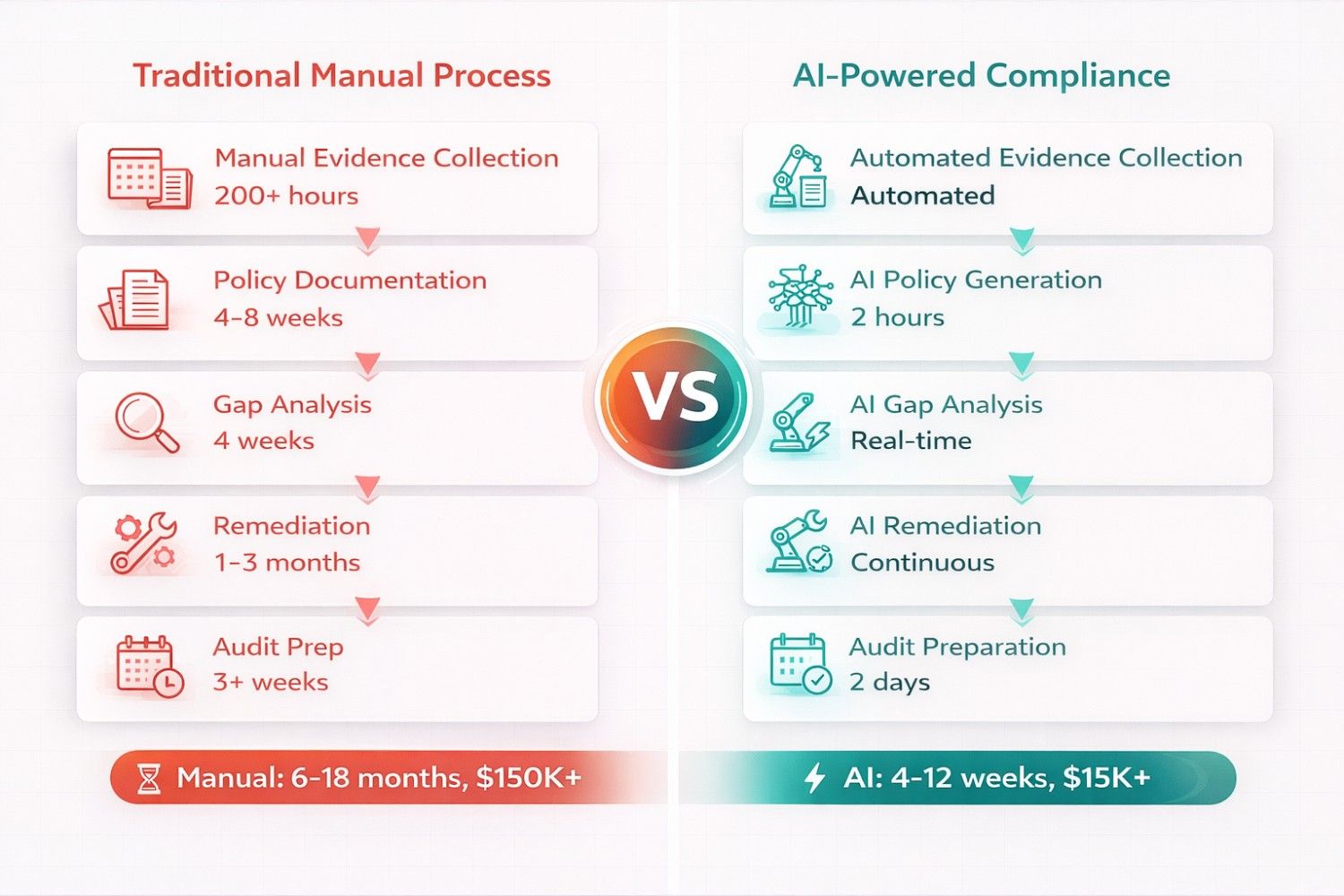
One of the most compelling reasons to adopt SOC 2 compliance AI tools is the dramatic cost reduction compared to manual compliance programs.
| Cost Factor | Manual Compliance | AI-Powered Compliance | Savings |
|---|---|---|---|
| Consulting fees | $50,000–$200,000 | $0–$15,000 | 70–100% |
| Internal labor (hours) | 500–2,000 hours | 50–200 hours | 80–90% |
| Evidence collection | 200+ hours | Automated | ~95% |
| Annual maintenance | $30,000–$80,000/yr | $5,000–$25,000/yr | 60–85% |
| Time to first audit | 6–18 months | 4–12 weeks | 75–90% |
| Audit preparation | 4–8 weeks | 1–2 days | ~95% |
For a typical mid-market SaaS company, switching from manual to AI-powered compliance saves between $75,000 and $250,000 in the first year alone, while reducing internal team burden by 80%.
⚠️Common SOC 2 Compliance Mistakes to Avoid
Even with the best AI tools, organizations make critical errors that delay certification or lead to audit failures. Avoid these pitfalls:
1. Starting Too Late Don't wait until a prospect requires your SOC 2 report. Start at least 6 months before you anticipate needing it—even with AI acceleration, Type II requires an observation period.
2. Ignoring Scope Definition Not everything in your company needs to be in scope. Carefully define which systems, teams, and data flows are relevant. AI tools can help map this, but the strategic decision is yours.
3. Treating It as a One-Time Project SOC 2 is an ongoing commitment. Your controls must operate continuously, not just during the audit window. This is exactly why AI cybersecurity tools with continuous monitoring are essential.
4. Neglecting Employee Training Your security policies are useless if employees don't follow them. Use AI writing tools to create clear, readable security policies, and implement automated training tracking.
5. Choosing the Wrong Auditor Not all CPA firms understand modern cloud infrastructure. Choose an auditor experienced with SaaS companies and comfortable with AI-collected evidence. Most platforms like Vanta and Drata maintain vetted auditor networks.
📌Integrating SOC 2 AI Tools Into Your Security Stack
For maximum effectiveness, your SOC 2 compliance AI tool should integrate with your broader security and development infrastructure:
- Cloud Security: Connect directly to AWS Security Hub, Azure Defender, or GCP Security Command Center for real-time posture data
- Identity & Access: Integrate with Okta, Azure AD, or Google Workspace to monitor access controls and MFA compliance
- Code Security: Link to GitHub Copilot and your CI/CD pipeline to validate secure development practices
- Communication: Feed alerts into Slack or Microsoft Teams for real-time compliance notifications
- Automation: Use Zapier to connect compliance workflows with your project management and ticketing systems
- Documentation: Leverage AI assistants like Claude to draft, review, and update security policies and procedures
If you're evaluating enterprise-grade AI platforms beyond compliance, our best enterprise AI software guide covers the full landscape.
For a deeper dive into how AI is reshaping cybersecurity beyond compliance, read our comprehensive guide on cybersecurity in the age of AI.
📌The Future of SOC 2 Compliance AI (2026 and Beyond)
The compliance automation space is evolving rapidly. Here's what's coming:
Autonomous Compliance Agents: In 2026, we're already seeing AI agents that don't just monitor and alert—they actively remediate issues. An MFA exception? The agent re-enables it. An expired SSL certificate? Auto-renewed. This is the agentic AI approach applied to compliance.
Real-Time Audit Readiness: The traditional "audit preparation period" is disappearing. With continuous evidence collection and real-time control monitoring, organizations will shift to always-on audit readiness, making the annual audit cycle feel seamless rather than stressful.
AI Auditors: Forward-thinking audit firms are experimenting with AI-powered audit review tools that can analyze evidence packages, identify anomalies, and draft audit opinions. While human auditors will remain essential for judgment calls, AI will dramatically accelerate the audit itself.
Unified Compliance Platforms: The trend toward single platforms covering SOC 2 + ISO 27001 + HIPAA + GDPR + PCI DSS will accelerate. If you're choosing the right AI tool for your business, look for vendors investing in multi-framework capabilities.
❓Frequently Asked Questions
What is SOC 2 compliance AI?
SOC 2 compliance AI refers to artificial intelligence tools and platforms that automate the process of achieving and maintaining SOC 2 certification. These tools use machine learning and AI agents to automate evidence collection, continuously monitor security controls, perform gap analysis, generate compliance documentation, and prepare audit-ready reports—replacing the traditional manual, spreadsheet-driven compliance process.
How much does AI-powered SOC 2 compliance cost?
AI-powered SOC 2 compliance tools range from $5,000/year (Sprinto) to $100,000+/year (AuditBoard for large enterprises). The typical mid-market SaaS company should budget $10,000–$25,000/year for the platform plus $15,000–$35,000 for the audit itself. This represents a 60–85% savings compared to traditional manual compliance programs.
How long does it take to get SOC 2 certified with AI tools?
With AI-powered compliance platforms, SOC 2 Type I certification can be achieved in 2–8 weeks (compared to 3–6 months manually). SOC 2 Type II requires an observation period of 3–12 months, but AI tools dramatically reduce the preparation and ongoing maintenance burden during that period.
Do I need SOC 2 if I already have ISO 27001?
While ISO 27001 and SOC 2 share significant overlap, they serve different markets. SOC 2 is the dominant compliance standard in North America, particularly for SaaS companies selling to US enterprises. ISO 27001 is more prevalent in Europe and Asia-Pacific. Many companies pursue both—and multi-framework AI tools like Drata and Vanta make this efficient by mapping shared controls automatically.
Can AI tools replace my compliance consultant?
AI tools can replace 70–90% of the manual work traditionally done by compliance consultants, particularly evidence collection, policy drafting, and gap analysis. However, strategic guidance on scope definition, risk assessment interpretation, and audit firm selection still benefits from human expertise. Many AI platforms now offer compliance advisory as an add-on service.
What integrations should my SOC 2 AI tool support?
At minimum, your SOC 2 AI tool should integrate with: your cloud provider (AWS, Azure, GCP), identity provider (Okta, Azure AD), version control system (GitHub, GitLab), HR system, endpoint management tool, and communication platform (Slack, Teams). The more native integrations, the less manual evidence collection you'll need to do.
⚖️Conclusion: Your SOC 2 Compliance Roadmap
SOC 2 compliance is no longer a nice-to-have checkbox—it's a revenue enabler. Every enterprise sales deal, every partnership agreement, and every regulated industry contract will eventually ask for your SOC 2 report.
The good news: SOC 2 compliance AI tools have made certification faster, cheaper, and less painful than ever before. Whether you choose Vanta for its integration depth, Drata for multi-framework coverage, Secureframe for developer experience, or Sprinto for budget efficiency, the key is to start now.
Here's your immediate action plan:
- This week: Audit your current tech stack and list all systems that handle customer data
- Next week: Request demos from 2–3 vendors on our list that match your size and budget
- Within 30 days: Begin automated evidence collection and gap analysis
- Within 90 days: Be audit-ready for SOC 2 Type I
For more insights on building a secure, AI-powered business infrastructure, explore our AI cybersecurity tools guide and our comprehensive AI tool selection playbook.
This vendor guide is independently researched by the AI Fuel Hub editorial team. We evaluate tools based on hands-on testing, vendor documentation, customer interviews, and publicly available audit data. Rankings reflect our editorial assessment as of February 2026.
Tools Mentioned in This Article
AI Fuel Hub Editorial Team
A collective of AI researchers, engineers, and product experts dedicated to testing and reviewing AI tools. Combined 50+ years of experience in artificial intelligence.