AI Employee Management Software: Hire, Train, Retain
Stop losing good people to clunky HR systems. These AI employee management tools handle recruiting, onboarding, training, and retention—so your managers can focus on leading, not paperwork.

In this article
AI Employee Management Software: Hire, Train, Retain
Last Updated: March 2, 2026
Here's a number that should make any business owner pause: according to Gallup, replacing a single employee costs between 50% and 200% of their annual salary. For a $60,000/year role, that's potentially $120,000 gone—in recruitment fees, training time, the productivity dip while someone new gets up to speed, and the ripple effect on the team that stays.
Now imagine managing all of that with spreadsheets and gut instinct. That was reality for most HR teams five years ago.
AI employee management software changed the math. Today, the same platforms that enterprise giants like Google and Amazon use to attract and keep top talent are available—often for a few hundred dollars a month—to teams as small as five people.
I've spent time with dozens of these tools, both as an evaluator and watching them transform real HR departments. This guide covers what actually works, what's marketing fluff, and how to match the right tool to your specific situation.

⚡ Jump to What You Need
- Best Overall: Workday (AI Core)
- Best for SMBs: BambooHR + AI
- Best Hiring Platform: Greenhouse AI
- Best Retention Analytics: Lattice AI
- Best Free Option: Zoho People
📌What Is AI Employee Management Software?
AI employee management software is an HR platform that uses artificial intelligence—machine learning, natural language processing, and predictive analytics—to automate and improve the most time-consuming parts of the employee lifecycle.
But here's the key distinction most vendor marketing ignores: not all "AI HR software" is equal. There are three genuine tiers:
Tier 1 – Rule-Based Automation (Not True AI) Software that sends automated birthday emails, generates contract PDFs, and reminds managers of review dates. Useful. Not AI.
Tier 2 – Machine Learning Insights Tools that analyze historical data to surface patterns: which candidates historically performed best, which roles have the highest turnover, which training paths lead to promotion. This is real AI and genuinely valuable.
Tier 3 – Generative + Predictive AI Modern platforms using LLMs and advanced models to write job descriptions, predict which employees are "flight risks" 90 days before they quit, and personalize learning paths to individual employees. This is where the market is heading fast in 2026.
The tools in this guide primarily sit in Tier 2 and Tier 3.
📌Why Traditional HR Software Is No Longer Enough
Let me be direct with you: if you're still running your people operations on spreadsheets, a basic HRIS (Human Resources Information System), or a tool you haven't updated in three years, you're operating at a structural disadvantage.
The three biggest pain points I hear from HR leaders who made the switch:
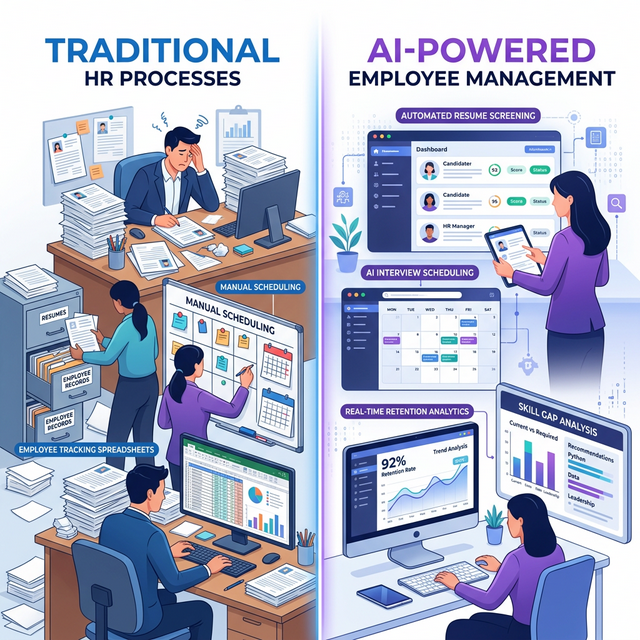
1. Hiring Takes Forever The average time-to-hire for professional roles is 44 days in the U.S. For engineering roles, it's often 60+. AI-powered screening and interview scheduling can cut that timeline by 30-40% for many companies.
2. Training Doesn't Stick The traditional approach: put new hires through the same 40-hour onboarding. The AI approach: analyze what skills the new hire already has, what their role actually requires, and generate a personalized learning path that skips the stuff they already know and doubles down on the gaps.
3. Retention Is Reactive Most companies discover an employee is unhappy when they hand in their resignation. AI-powered engagement tools identify the early warning signals weeks or months earlier—a drop in meeting participation, fewer contributions to shared documents, declining pulse survey scores—when there's still time to intervene.
🏆The 8 Best AI Employee Management Software Platforms in 2026
1. Workday (AI Core & ML) {#workday}
Best For: Mid-market to enterprise organizations (500+ employees)
Workday is the benchmark. If you ask any enterprise HR leader what platform they'd build on if starting fresh, a significant chunk would say Workday—not because it's the flashiest, but because its data model is the best foundation for AI to work on.
Their AI Core layer sits across the entire platform: HCM (Human Capital Management), Recruiting, Learning, and Payroll. The key feature that separates Workday from almost everything else is that it doesn't treat hiring, performance, and learning as separate databases. It's one integrated data model, which means the AI can actually connect patterns across the entire employee lifecycle.
Key AI Features:
- Workday Assistant: Natural language chatbot for employees and managers. Ask "Who in my team has Python skills?" and get an actual answer from HR data.
- AI-Powered Skills Cloud: Automatically infers employee skills from their project history, learning completions, and job history—building a living skills inventory without employees manually updating profiles.
- Recruiting AI: Scores candidates against your top performers, not just job description keywords.
- Flight Risk Prediction: Uses engagement data, tenure, compensation data, and external market signals to flag retention risks before employees start job searching.
- Learning Recommendation Engine: Suggests next courses and development paths based on an employee's current skills and their stated career goals.
Pricing:
- Enterprise pricing (custom quote required)
- Typically $15–$40+ per employee per month depending on modules
Honest Take: Don't buy Workday for a team of 50. The implementation complexity and cost are real, and you won't get the ROI until you're pushing 300+ employees. But at that scale, it's exceptional.
2. BambooHR (+ AI Features) {#bamboohr}
Best For: Small to mid-sized businesses (10–500 employees) that want power without the complexity
BambooHR is the tool that SMB HR managers actually love using. While it's not as AI-heavy as some larger platforms, their recent additions—particularly around hiring and reporting—make it genuinely useful for smaller teams.
What BambooHR does incredibly well is reduce the administrative burden on HR professionals who wear many hats. The interface is genuinely intuitive (rare in HR software), and the mobile app is solid—meaning managers actually use it.
Key AI Features:
- Hiring Pipeline Analytics: Uses your historical data to show you where candidates are dropping out and which sources produce your best hires.
- AI-Powered Applicant Scoring: Ranks applicants against defined criteria so recruiters review the most promising candidates first.
- Employee NPS + Turnover Predictor: Automated eNPS surveys with analytics that flag teams with declining satisfaction scores.
- Smart Reporting: Natural language report generation—ask "Show me headcount by department for last 6 months" and get a chart, not a manual data pull.
Pricing:
- Essentials: ~$6/employee/month (minimum fees apply)
- Advantage: ~$9/employee/month (includes AI features, advanced reporting)
Honest Take: The best-value HR software for companies between 30–250 people. If you've outgrown spreadsheets but aren't ready for a Workday implementation, BambooHR is where I'd point you.
3. Greenhouse {#greenhouse}
Best For: Companies serious about structured, equitable, data-driven hiring
Greenhouse isn't a full HRIS—it's purpose-built for recruiting. But it's arguably the best AI-augmented hiring platform available, and for companies making 10+ hires a month, it's worth using alongside a separate HRIS.
Their philosophy is deliberate: define what "great" looks like for a role before you start screening candidates, then use data to reduce bias and improve consistency. The AI layer helps automate the tedious parts while keeping humans in control of the final decisions.
Key AI Features:
- Candidate Scoring: Ranks applicants based on your custom-weighted criteria (not just keyword matching).
- Interview Kit AI: Generates structured interview questions tailored to the specific role and competencies you've defined.
- Source Analytics: Shows you which job boards, employee referrals, and agencies produce your highest performers—not just hires.
- Offer Accept Prediction: ML model that estimates the probability a candidate will accept an offer given market data and your company profile.
Pricing:
- Custom pricing (~$6,000–$50,000/year depending on company size and modules)
Honest Take: Greenhouse is a premium product with enterprise-level service. If hiring velocity and quality are your biggest HR challenge, it's worth every dollar. If you're making fewer than 2–3 hires a month, the cost is hard to justify.
4. Lattice (AI-Powered Performance & Retention) {#lattice}
Best For: Companies where employee engagement and retention are the top HR priority
Lattice sits at the intersection of performance management and people analytics. Their recent AI additions have made it one of the most sophisticated retention tools available to companies that aren't Workday customers.
The insight that drives Lattice's value proposition: most employee problems are visible in the data weeks before a manager notices them. Lattice's AI is designed to surface those signals early.
Key AI Features:
- AI-Assisted 1:1 Agendas: Suggests discussion topics for manager-employee meetings based on recent work activity, performance trends, and stated goals.
- Engagement Risk Signals: Flags employees whose engagement scores, performance metrics, or goal completion rates are trending downward.
- Compensation Analysis: Compares your compensation against market benchmarks and flags potential pay equity issues before they become legal or retention problems.
- Goal Cascading AI: Helps managers break down company-level OKRs into individual contributor goals that actually make sense.
Pricing:
- Talent Management: $11/person/month
- Combined Platform: $17–$25/person/month
- Enterprise: Custom pricing
Honest Take: Lattice is genuinely excellent for any company that takes performance culture seriously. The AI features are well-integrated and practical—not bolted-on. Pair it with BambooHR (for HRIS) and Greenhouse (for hiring) if you're an SMB.
5. Zoho People (Most Accessible Option) {#zoho-people}
Best For: Small businesses or companies already using the Zoho ecosystem
Zoho People is the best-value entry point into AI-assisted employee management. If budget is a real constraint and you need core HR plus AI features without enterprise pricing, this is where I'd start.
Their AI assistant Zia (the same assistant powering Zoho Desk and Zoho CRM) has been integrated across the People platform for attendance analysis, performance monitoring basics, and HR chatbot functionality.
Key AI Features:
- Zia HR Chatbot: Answers employee questions about leave balance, company policies, and payslips without routing to HR.
- Attendance Pattern Analysis: Flags anomalous attendance patterns (potential issues before they become policy violations).
- Performance Trend Reports: Automated tracking with basic trend analysis across teams.
- Case Management AI: Routes employee HR queries to the right department automatically.
Pricing:
- Essential HR: $1/employee/month (very limited)
- Professional: $2/employee/month
- Premium: $3/employee/month (includes Zia AI, performance management)
- Enterprise: $5/employee/month (full suite)
Honest Take: The price point is genuinely impressive. For a 50-person company, you could run full HR operations with AI assistance for $150–$250/month. Not as powerful as Workday or Lattice, but 95% of what a growing business actually needs.
6. Rippling
Best For: Remote-first and globally distributed teams needing HR + IT + Payroll in one system
Rippling is the most ambitious product in this space—it's not just HR software, it's a unified platform for running your entire workforce (and the devices and apps they use). The AI features are newer than some competitors, but the fundamental data architecture—where every tool a company uses connects to one employee record—makes the AI surprisingly powerful.
When an employee is onboarded in Rippling, their laptop gets configured, their Slack/Gmail/Notion/Salesforce access gets provisioned, payroll is set up, and benefits enrollment is triggered—automatically, in sequence, without separate admin steps.
Key AI Features:
- Headcount Planning AI: Predicts hiring needs based on revenue projections, historical growth data, and role attrition rates.
- Workflow Automation: AI-suggested automation rules based on what similar companies in their database are doing.
- Compliance AI: Automatically updates payroll and HR settings as employment laws change by state/country—critical for remote teams.
- Analytics Hub: Cross-functional analytics that combine HR, payroll, and IT data into unified workforce intelligence.
Pricing:
- Starts at ~$8/employee/month (base) + cost per module
- Full platform typically $20–$35/employee/month
Honest Take: The killer feature for Rippling isn't any single AI capability—it's the unified data model. Once your HR, IT, and payroll are all talking to each other, the automation possibilities are genuinely transformative. Best for companies with 50–1,000 employees, especially remote-first.
7. Leapsome (AI Learning & Engagement)
Best For: Companies prioritizing learning culture and continuous feedback
Leapsome takes a fundamentally different approach than most HR platforms. While others start with the administration (payroll, time-off, compliance) and add engagement features on top, Leapsome starts with employee development and adds structure around it.
Their AI-powered learning and feedback engine is particularly strong—it's one of the few tools I've seen that creates genuinely personalized learning experiences that employees actually complete.
Key AI Features:
- AI Goal Coach: Helps managers and employees write SMART goals using natural language, then suggests leading metrics to track them.
- Personalized Learning Paths: Analyzes role requirements, skill assessments, and career goals to recommend specific content from their integrated library.
- Feedback Intelligence: Detects patterns in peer and manager feedback to surface development themes the employee might not have noticed themselves.
- Engagement Heatmaps: Visual representation of which teams and managers are driving high engagement vs struggling.
Pricing:
- Learning & Development: $8/user/month
- Full Platform: $14–$20/user/month
- Enterprise: Custom
Honest Take: Leapsome is the tool for companies building a genuine learning culture, not just checking compliance boxes. If "we invest in our people" is a core brand claim your business makes, Leapsome gives you the operational foundation to actually back that up.
8. Eightfold AI
Best For: Enterprise companies focused on skills-based talent intelligence
Eightfold is where AI for talent management is heading. Built from the ground up on a deep learning model trained on hundreds of millions of career trajectories, it's the most sophisticated AI talent platform I've evaluated.
The core insight: most companies make hiring and promotion decisions based on job titles and credentials. But those are poor proxies for actual capability. Eightfold's AI builds a skills-based graph of your workforce and external candidates, matching people to opportunities based on transferable capabilities that a keyword-based ATS would miss.
Key AI Features:
- Career Path AI: Shows employees multiple potential growth trajectories within your organization—dramatically improving internal mobility.
- Skills Inference Engine: Infers skills from career history, projects, and education—then maps them to your specific role requirements.
- Diversity Pipeline Analytics: Actively identifies high-potential diverse candidates that traditional recruiting processes systematically miss.
- Talent Redeployment: When a team is restructured or role eliminated, finds internal matches before an employee has to be let go.
Pricing:
- Enterprise pricing only (typically $20–$50+/employee/month depending on modules)
Honest Take: If you're at 1,000+ employees and talent intelligence is a strategic priority, Eightfold is remarkable. For companies under 500, the ROI isn't there yet—but watch this space.
📌Head-to-Head Comparison
| Platform | Best For | Starting Price | AI Hiring | AI Retention | Learning AI | Free Trial |
|---|---|---|---|---|---|---|
| Workday | Enterprise (500+) | Custom | ✅ Advanced | ✅ Advanced | ✅ Advanced | ❌ Demo only |
| BambooHR | SMB (10–500) | ~$6/emp/mo | ✅ Basic | ✅ Basic | ❌ Limited | ✅ 7 days |
| Greenhouse | Recruiting-focused | ~$6k+/yr | ✅ Advanced | ❌ N/A | ❌ N/A | ✅ Demo |
| Lattice | Performance/Retention | $11/person/mo | ❌ Limited | ✅ Advanced | ✅ Good | ✅ 14 days |
| Zoho People | Budget-conscious SMB | $1/emp/mo | ✅ Basic | ✅ Basic | ✅ Basic | ✅ 30 days |
| Rippling | Remote/Distributed | ~$8/emp/mo | ✅ Good | ✅ Good | ❌ Limited | ✅ Demo |
| Leapsome | Learning culture | $8/user/mo | ❌ Limited | ✅ Good | ✅ Advanced | ✅ 14 days |
| Eightfold AI | Enterprise talent intel | Custom | ✅ Best in class | ✅ Advanced | ❌ Limited | ❌ Demo only |
📖How AI Employee Management Works: The Three Pillars
The best way to think about AI's role in employee management is through three distinct phases of the employee lifecycle. Here's what the technology actually does at each stage.
Pillar 1: AI-Powered Hiring
The traditional hiring funnel is brutally inefficient. A single job posting for a software role might generate 400 applications. A recruiter physically cannot evaluate 400 resumes with proper care—so they skim, pattern-match, and unconsciously apply the same biases that limit diverse hiring.
AI hiring tools attack this problem at several points:
Job Description Optimization: AI analyzes which language in job descriptions attracts diverse, high-quality candidates and which inadvertently filters them out. The word "rockstar," for example, statistically skews male applicants.
Automated Screening: ML models score inbound applications against your defined criteria and historical performance data—presenting recruiters with a ranked shortlist of the most promising candidates, not just the first 20 who applied.
Interview Scheduling Automation: AI eliminates the back-and-forth email chains that routinely add 3–5 days to scheduling. Candidates self-serve into available slots; AI handles the coordination.
Bias Reduction: Anonymizing candidate information (name, university, graduation year) and standardizing interview evaluations reduces unconscious bias in ways that training alone never achieves.
For businesses looking to streamline their broader operations with AI, our related guide on AI CRM software shows how sales and talent systems can integrate to create a unified growth machine.
Pillar 2: AI-Powered Training & Onboarding
The failure mode of traditional onboarding: sit a new hire in a conference room for a week, run them through the same slideshow everyone sees, then throw them into the deep end and wonder why productivity ramps slowly.
AI personalizes this from day one.
Skill Gap Analysis: Before onboarding starts, the AI assesses what the new hire already knows (from their application, assessments, and interview notes) and maps it against what the role requires. The training path is built around the delta—not a generic checklist.
Adaptive Learning Paths: As the employee completes modules and takes assessments, the system adjusts future content recommendations. Struggling with a concept? It presents the material differently. Breezing through foundational content? It accelerates to advanced material.
Role-Specific Content Generation: Modern platforms can generate custom training content (quizzes, case studies, scenarios) based on your specific products, processes, and culture—not just generic e-learning library content.
30-60-90 Day Milestone Tracking: AI flags when new hires are falling behind key milestones and suggests manager interventions before small problems become early departures. Given that AI project management tools are now tracking cross-functional work automatically, the best platforms integrate onboarding goals with actual project contribution metrics.
Pillar 3: AI-Powered Retention
This is where the ROI of AI employee management becomes most visible—and most underchallenged by conventional HR tools.
Predictive Flight Risk Models: By analyzing dozens of variables—engagement survey scores, performance ratings, internal mobility history, peer interaction patterns, external salary benchmarks, peer departures—modern AI can flag employees at high turnover risk 60–120 days before they give notice.
That's the window when you can actually do something: a compensation conversation, a stretch assignment, an honest career discussion. After someone's handed in their resignation, those conversations rarely change outcomes.
Personalized Career Path Visibility: One of the most common exit interview answers is "I didn't see a future here." AI-powered career pathing tools show employees exactly which roles their current skills qualify them for, what gaps they need to close, and who internally has made similar transitions. Visibility creates hope. Hope keeps people.
Continuous Pulse Surveys: Annual engagement surveys are useless—too infrequent and too lagging to drive action. AI-powered micro-pulse surveys (2–3 questions, weekly) with automated analysis give HR teams a real-time read on team health, with trend analysis that identifies issues before they become cultural crises.
📌Choosing the Right Platform: A Decision Framework
The biggest mistake companies make when evaluating AI employee management software is starting with features instead of problems. Here's the framework I use:
Step 1: Define Your Biggest HR Pain Point
High volunteer turnover? → Prioritize retention analytics. Look at Lattice or Leapsome first.
Can't fill roles fast enough? → Your hiring bottleneck is the issue. Start with Greenhouse or the AI hiring module of BambooHR.
New hires taking too long to perform? → Onboarding and training. Look at platforms with strong learning features (Leapsome, Workday Learning, BambooHR Onboarding).
Drowning in HR administration? → You need a better HRIS foundation. BambooHR or Rippling for SMBs; Workday for enterprise.
Remote team complexity? → Rippling is purpose-built for this.
Step 2: Match Complexity to Your Team Size
| Company Size | Recommended Starting Point |
|---|---|
| 1–30 employees | Zoho People (budget-conscious) or BambooHR Essentials |
| 30–150 employees | BambooHR Advantage or Rippling Core |
| 150–500 employees | Lattice + BambooHR, or Rippling Full Platform |
| 500–2,000 employees | Workday HCM or Greenhouse + Lattice |
| 2,000+ employees | Workday or Eightfold AI |
Step 3: Evaluate for Integration, Not Features
An AI HR tool in isolation is far less powerful than one connected to your other business systems. Before buying any platform, ask:
- Does it connect to your ATS or HRIS if buying a point solution?
- Can it ingest payroll data to contextualize compensation analytics?
- Does it integrate with your communication tools (Slack, Teams)?
- Can it connect to project management tools to track actual work outputs?
The businesses getting the most from AI employee management aren't running the "best" platform in isolation—they're running well-integrated platforms where the HR data talks to the sales data, the finance data, and the operations data.
⚠️5 Mistakes to Avoid When Implementing AI HR Software
Mistake #1: Buying Before Auditing Your Data
AI is only as good as the data it trains on. If your employee records are incomplete, your performance ratings are inconsistent, or your HRIS has years of orphaned records, the AI will surface garbage insights. Before any implementation, clean your people data.
Mistake #2: Skipping Manager Buy-In
HR can select the best tool in the world, but if managers don't see value in updating goal records, doing pulse surveys, or checking AI retention flags—the tool fails. Involve your managers in the selection process. Show them specifically how the tool saves them time or makes them better leaders.
Mistake #3: Treating AI Recommendations as Decisions
AI identifies that an employee is at "high flight risk." A manager uses that as pretext to manage them out rather than have a real conversation. This is how AI becomes a liability. The AI surfaces; the human decides. Build this into your training and your processes.
Mistake #4: Ignoring the Employee Experience
Every AI feature has an employee-facing side. Pulse surveys feel like surveillance if not explained well. Performance scoring feels unfair if the criteria are opaque. Communication is as important as the technology. Be transparent about what data is being collected, how it's used, and what employees gain from participation.
Mistake #5: Measuring ROI Too Early
The impact of better retention analytics often shows up 6–12 months post-implementation, when voluntary turnover starts declining. Don't pull the plug on a platform after 90 days because you haven't seen a budget line move yet. Define your success metrics upfront and commit to measuring at the right time horizons.
📌The ROI of AI Employee Management: What the Numbers Say
The business case for AI employee management isn't theoretical. Here's what research and early adopters are reporting:
- 25–40% reduction in time-to-fill for open roles using AI screening (LinkedIn Talent Solutions, 2025)
- 30% improvement in offer acceptance rates when AI helps personalize the candidate experience
- 15–20% reduction in first-year turnover for companies using AI-powered onboarding programs
- 50–60% of at-risk employees retained when proactive interventions happen within the early warning windows AI identifies
- $2,000–$8,000 per hire saved in agency and recruitment costs when internal AI tools reduce dependence on external recruiters
For a growing company making 30 hires a year, that last number alone represents $60,000–$240,000 in direct savings—before even accounting for the retention improvements.
❓Frequently Asked Questions
What is AI employee management software? ▼
AI employee management software uses machine learning, natural language processing, and predictive analytics to automate and improve HR processes across the employee lifecycle—from recruiting and onboarding to performance management and retention. Unlike traditional HR systems, AI platforms identify patterns and surface insights that would take human analysts hours or days to compile, and they do it in real time.
Can small businesses afford AI employee management tools? ▼
Absolutely. Zoho People starts at $1–$5/employee/month. BambooHR is around $6–$9/employee/month. For a 30-person company, that's $90–$270/month for a fully functional AI-assisted HR platform. Compare that to the cost of a single bad hire ($30,000–$120,000) and the ROI case is straightforward even at small scale.
Does AI employee management replace HR teams? ▼
No—and the companies that approach it this way typically get the worst results. AI handles the data analysis, the administrative automation, and the pattern recognition. Human HR professionals handle the judgment calls: the difficult conversation, the exception case, the nuanced culture read. The best implementations augment HR teams, not replace them. The most effective HR professionals at AI-forward companies are spending less time on paperwork and more time on strategic work that requires human empathy and judgment.
How does AI predict employee turnover? ▼
AI retention models analyze dozens of signals: engagement survey trends, performance rating trajectories, internal application activity, peer departure rates on the same team, compensation relative to market benchmarks, time since last promotion, manager quality scores, and more. The ML model is trained on historical data of who left and who stayed, learning which combinations of signals most reliably predict departures. Most platforms report 70–85% accuracy in identifying at-risk employees 60–90 days before resignation.
Is AI in hiring biased? ▼
This is one of the most important questions in the space. AI can perpetuate existing biases if trained on historically biased data—Amazon famously abandoned an AI hiring tool in 2018 because it was penalizing female candidates. The best modern platforms (Eightfold, Greenhouse, Workday) actively test for demographic bias in their models and build in bias-mitigation features: skills-based matching that de-emphasizes credential signals, structured interview frameworks, and diversity pipeline analytics. No tool is perfectly bias-free, but thoughtfully implemented AI reduces systematic bias compared to unstructured human screening. Always audit your own hiring data annually.
What's the difference between HRIS, HCM, and AI HR software? ▼
HRIS (Human Resources Information System) is the foundational database—employee records, org charts, time-off tracking, payroll. HCM (Human Capital Management) is broader and includes talent management: recruiting, performance, learning, succession planning. AI HR software can describe either tier, but specifically refers to platforms that use machine learning and generative AI to surface insights, automate judgment tasks, and personalize experiences—rather than just storing and displaying data. Workday HCM with AI Core is all three; Zoho People leans more HRIS with AI assistance layered on top.
📌Related Resources
If you found this guide useful, here are related resources for building your full AI-powered business toolkit:
- 🤖 AI Help Desk Software: Top Solutions for Small Business — The support side of your employee experience
- 📊 AI CRM Software: Best Picks for 2026 — Connect your people data with your revenue data
- 🛠️ AI Project Management Tools That Actually Work — How your team's work gets done more effectively
- 💼 Best AI Business Tools: Complete Guide for 2026 — The full business AI toolkit
- 🎯 AI Customer Service Tools That Reduce Support Costs — The customer-facing complement to great internal HR
Looking for authoritative third-party research on workforce AI?
- Gallup's State of the Global Workplace Report — Essential reading on employee engagement data
- SHRM's AI in HR Resource Center — Society for Human Resource Management's official guidance on AI adoption
🏆Conclusion: The Best AI Employee Management Software for Your Situation
The right AI employee management tool depends entirely on where your biggest pain is:
Start with Zoho People if you're budget-constrained and want to test the waters with AI HR at low risk.
Choose BambooHR if you're an SMB that wants excellent UX, solid AI assistance, and a platform your managers will actually log into.
Go with Greenhouse if hiring quality and speed is your single biggest HR bottleneck.
Pick Lattice if your challenge is performance culture and stopping your best people from quietly searching for their next job.
Invest in Rippling if your team is remote or distributed and HR + IT + payroll complexity is costing you real time and money.
Look at Workday or Eightfold when you're past 500 employees and talent intelligence is a genuine strategic differentiator.
None of these tools are magic. The companies getting real ROI from AI employee management share three things: they cleaned their data before implementing, they got manager buy-in before rolling out, and they committed to measuring the right metrics at the right time horizons.
The era of managing your most important asset—your people—with gut instinct and spreadsheets is ending. The companies replacing those habits with AI-assisted decisions today will have a structural talent advantage that compounds for years.
What's your current biggest HR challenge—hiring, training, or retention? I'm curious what specific pain points brought you to this guide.
Tools Mentioned in This Article
AI Fuel Hub Editorial Team
A collective of AI researchers, engineers, and product experts dedicated to testing and reviewing AI tools. Combined 50+ years of experience in artificial intelligence.