How to Implement AI in Your Business (Step-by-Step Guide)
A complete, actionable guide to implementing AI in your business—from identifying high-ROI use cases and auditing data readiness to choosing the right tools, building pilot projects, and scaling enterprise-wide. Proven strategies for companies in the US, UK, Canada, and beyond.

In this article
How to Implement AI in Your Business: The Complete Step-by-Step Guide (2026)
Last Updated: February 13, 2026
Artificial intelligence is no longer a futuristic concept reserved for Silicon Valley giants. According to McKinsey, 72% of organizations worldwide have adopted AI in at least one business function as of 2026—up from just 20% in 2017. Yet a staggering 70% of AI implementations fail to deliver meaningful ROI, primarily due to poor strategy.
If your company is exploring enterprise AI solutions or looking for the best AI tools for small businesses, this guide will show you exactly how to go from evaluation to execution.
📌Why You Need to Implement AI in Your Business Now
The competitive gap between AI-adopting and non-adopting businesses is widening rapidly. PwC's Global AI Study projects AI will contribute $15.7 trillion to the global economy by 2030—more than the current output of China and India combined.
Here's what the data shows for businesses in Tier 1 markets (United States, United Kingdom, Canada, Germany, Australia):
- Companies using AI report 3–15% revenue increases within 12 months (Harvard Business Review)
- 40% reduction in operational costs through intelligent automation (Forrester Research)
- AI-first companies are 2.5x more likely to be top-quartile performers (McKinsey)
- Customer satisfaction scores improve 25–35% when AI is deployed in service operations
- $4.4 billion in VC funding was directed at enterprise AI startups in Q4 2025 alone
The message is clear: businesses that fail to implement AI in business operations risk falling behind competitors who have already gained an efficiency advantage. Whether you're a startup founder in San Francisco, a mid-market retailer in London, or a manufacturing firm in Toronto, the playbook is the same.
🎯Step 1: Identify Business Problems AI Can Solve
The biggest mistake companies make is adopting AI for the sake of adopting AI. Successful implementation starts by identifying specific, measurable business problems where AI delivers clear value.
High-ROI AI Use Cases by Department
| Department | AI Use Case | Expected ROI | Time to Value |
|---|---|---|---|
| Customer Service | AI chatbots, ticket routing, sentiment analysis | 30–60% cost reduction | 1–3 months |
| Sales | Lead scoring, pipeline forecasting, outreach automation | 15–35% conversion increase | 2–4 months |
| Marketing | Content generation, ad optimization, personalization | 20–40% efficiency gains | 1–2 months |
| Operations | Demand forecasting, inventory optimization, quality control | 15–25% cost savings | 3–6 months |
| HR | Resume screening, employee engagement, workforce planning | 40–60% time savings | 1–3 months |
| Finance | Fraud detection, expense management, revenue forecasting | 25–50% accuracy improvement | 2–4 months |
| IT/Engineering | Code generation, bug detection, infrastructure monitoring | 20–45% productivity boost | 1–2 months |
For customer-facing operations, AI-powered chatbots typically deliver the fastest ROI. If your business runs on CRM systems, explore AI-powered CRM solutions that can automate lead management end-to-end.
Prioritization Framework
Score each potential use case on three dimensions:
- Business Impact (1–10): Revenue potential, cost savings, or competitive advantage
- Feasibility (1–10): Data availability, technical complexity, and team readiness
- Strategic Alignment (1–10): Alignment with company goals and customer needs
Multiply the scores to create a priority ranking. Start with the highest-scoring use case—this becomes your pilot project in Step 5.
🎯Step 2: Audit Your Data Readiness
AI is only as good as the data it learns from. Before you implement AI in business processes, conduct a thorough data audit:
The Data Readiness Checklist
- Data Volume: Do you have sufficient historical data? Most machine learning models need thousands (sometimes millions) of data points
- Data Quality: Are records complete, accurate, and consistently formatted? Clean 80% of data quality issues before starting
- Data Accessibility: Can your AI solution access the data it needs? Break down silos between departments
- Data Governance: Do you have clear policies on data ownership, privacy, and retention—especially for GDPR (EU/UK), CCPA (US), and PIPEDA (Canada)?
- Data Infrastructure: Is your storage scalable? Consider cloud AI platforms like AWS, Azure, or Google Cloud for enterprise-grade infrastructure
Common Data Pitfalls
Fragmented data across systems is the #1 killer of AI projects. If your customer data lives in one CRM, your sales data in another, and your marketing analytics in a third, invest in a data integration layer first. Companies in the US and UK report spending 40–60% of their AI budgets on data preparation—plan accordingly.
🎯Step 3: Choose the Right AI Tools and Platforms
Selecting the right tools is critical when you implement AI in business operations. The good news: you don't need to build AI from scratch. Modern AI platforms offer plug-and-play solutions for most business needs.
AI Tools by Category
For General Business AI:
- ChatGPT — Best overall AI assistant for business tasks, from email drafting to data analysis
- Claude — Ideal for nuanced communication, legal documents, and long-form business content
- Google Gemini — Seamless integration for businesses running on Google Workspace
For Sales & Marketing:
- HubSpot — AI-powered CRM with lead scoring, email automation, and analytics
- Jasper — Brand-consistent AI content creation for marketing teams
- Surfer SEO — AI-driven content optimization for organic search performance
- Copy.ai — GTM workflow automation for revenue teams
For Development & Engineering:
- GitHub Copilot — AI pair programmer that accelerates code writing by 30–55%
- Salesforce Einstein — Native AI within the Salesforce CRM ecosystem
For Customer Service: Check our detailed AI customer service tools guide for platforms like Intercom Fin, Tidio, and Zendesk AI that can automate 40–60% of support tickets.
Build vs. Buy Decision Matrix
| Factor | Build Custom AI | Buy Off-the-Shelf |
|---|---|---|
| Upfront Cost | $50K–$500K+ | $20–$500/mo per user |
| Time to Deploy | 3–12 months | 1 day – 4 weeks |
| Customization | Full control | Limited to platform |
| Maintenance | Your responsibility | Vendor managed |
| Data Privacy | Complete ownership | Shared infrastructure |
| Best For | Unique competitive advantage | Standard business processes |
For most small and mid-sized businesses, buying established AI tools is the fastest path to value. Reserve custom AI development for processes that are genuinely unique to your company and represent a competitive moat.
🎯Step 4: Build Your AI Implementation Team
You don't need a team of PhD data scientists to implement AI in business operations—but you do need the right roles in place.
Essential Roles for AI Implementation
| Role | Responsibility | Full-Time Needed? |
|---|---|---|
| AI Champion / Sponsor | Executive buy-in, budget allocation, strategic direction | Part-time |
| Project Manager | Timeline, milestones, cross-functional coordination | Yes |
| Data Engineer | Data pipelines, integration, quality assurance | Yes |
| AI/ML Engineer | Model selection, fine-tuning, deployment (if building custom) | Depends |
| Domain Expert | Business context, validation, user acceptance testing | Part-time |
| Change Manager | Training, adoption, resistance management | Part-time |
Hiring vs. Upskilling
According to LinkedIn's 2026 Workforce Report, AI-related job postings have increased 65% year-over-year in the US, UK, and Canada. However, talent remains scarce. Consider these strategies:
- Upskill existing employees with platforms like Coursera, Google AI certifications, or AWS Machine Learning training—often 50–70% cheaper than external hires
- Use AI consultancies for initial strategy and architecture—typical engagement costs $15K–$75K in Tier 1 markets
- Hire fractional AI leaders (CTO/CDO) if you're not ready for a full-time executive hire
🎯Step 5: Start with a Pilot Project
This is where theory meets practice. Your pilot project is a controlled experiment to implement AI in business with minimal risk and maximum learning.
The 90-Day Pilot Framework
Weeks 1–2: Setup
- Define success metrics (KPIs) before you start
- Select your AI tool and configure it for your use case
- Prepare training data and integrate with existing systems
Weeks 3–8: Execute
- Deploy the AI solution with a small user group (10–20% of the team)
- Monitor performance daily during the first two weeks
- Collect qualitative feedback from users alongside quantitative metrics
Weeks 9–12: Evaluate
- Compare AI-assisted performance against baseline metrics
- Calculate actual ROI: (Gains – Costs) / Costs × 100
- Document lessons learned, edge cases, and failure modes
- Make a go/no-go decision on full rollout
Pilot Project Examples
Example 1 — E-commerce (UK): A mid-size retailer deployed ChatGPT to handle 30% of customer inquiries. Result: 45% reduction in average response time and £120K annual savings in support costs after 90 days.
Example 2 — B2B SaaS (US): A SaaS company used HubSpot AI for lead scoring. Result: 28% increase in qualified leads passed to sales and a 22% improvement in close rates within one quarter.
Example 3 — Professional Services (Canada): A consulting firm adopted Claude for proposal writing and document analysis. Result: 35% time savings per proposal, enabling consultants to handle 40% more client work. Read more about how AI is transforming small business operations.
🎯Step 6: Integrate AI Into Existing Workflows
The difference between a successful AI implementation and a failed one often comes down to integration. AI solutions that exist in isolation get abandoned—those woven into daily workflows become indispensable.
Integration Best Practices
1. Embed AI Where People Already Work Don't force employees to switch between tools. Use AI integrations within your existing stack:
- Google Gemini inside Gmail, Docs, and Sheets
- Microsoft Copilot inside Word, Excel, and Teams
- Salesforce Einstein inside your CRM workflows
2. Automate the Handoff Build triggers that automatically invoke AI at the right moment:
- New support ticket → AI categorizes, drafts response, routes to agent
- New lead enters CRM → AI scores, enriches data, suggests outreach template
- Monthly reports due → AI generates first draft with key metrics and insights
3. Create Feedback Loops Implement systems where human corrections improve the AI over time:
- Flag incorrect AI outputs and use them for retraining
- Track accuracy metrics weekly during the first 90 days post-integration
- Schedule monthly "AI performance reviews" with stakeholders
Change Management Strategies
Employee resistance is the silent killer of AI adoption. Gartner reports that 47% of AI projects fail due to lack of user adoption, not technical shortcomings. Counter this with:
- Transparent communication: Frame AI as an assistant, not a replacement—emphasize job augmentation
- Hands-on training: Provide workflow-specific training, not generic AI overviews
- Quick wins: Showcase early results to build organizational momentum
- Champion networks: Identify AI power users in each department to mentor peers
🎯Step 7: Measure ROI and Scale Across the Organization
The final step to implement AI in business successfully is measuring results and expanding strategically.
Key Performance Indicators (KPIs) for AI Implementation
| KPI Category | Metrics to Track | Target Benchmark |
|---|---|---|
| Efficiency | Time saved per task, tasks automated per month | 25–50% improvement |
| Quality | Error rates, accuracy scores, CSAT scores | 15–30% improvement |
| Revenue | Conversion rates, average deal size, pipeline velocity | 10–25% increase |
| Cost | Cost per transaction, headcount efficiency, tool spend | 20–40% reduction |
| Adoption | Active users, feature utilization, user satisfaction | 70%+ adoption rate |
Scaling Strategies
Once your pilot proves ROI, scale using this playbook:
- Horizontal Scaling: Apply the same AI solution to additional teams (e.g., expand customer service AI from one region to all regions)
- Vertical Scaling: Deepen AI capabilities in the same department (e.g., add AI lead generation to your sales AI stack)
- Cross-Functional Scaling: Apply AI learnings from one department to another (e.g., marketing AI content workflows adapted for HR communications)
💰AI Implementation Cost Breakdown (2026)
Understanding costs is essential for budgeting when you implement AI in business. Here's what companies in Tier 1 markets typically spend:
| Cost Component | Small Business | Mid-Market | Enterprise |
|---|---|---|---|
| AI Software/Tools | $100–$2,000/mo | $2,000–$20,000/mo | $20,000–$200,000/mo |
| Data Preparation | $5K–$25K one-time | $25K–$100K | $100K–$500K |
| Implementation | $10K–$50K | $50K–$250K | $250K–$2M |
| Training & Change Mgmt | $2K–$10K | $10K–$50K | $50K–$200K |
| Ongoing Maintenance | $500–$2,000/mo | $2,000–$15,000/mo | $15,000–$100,000/mo |
| Est. Annual Total | $20K–$75K | $100K–$500K | $500K–$5M+ |
These figures represent averages across US, UK, Canadian, German, and Australian markets as of Q1 2026. Actual costs vary by industry, complexity, and vendor selection.
💡Pro Tip: Start with off-the-shelf AI tools to minimize upfront costs. You can always invest in custom AI solutions once you've validated the business case. Browse our complete AI tools directory to compare pricing across categories.
📌Common Mistakes When Implementing AI in Business
Avoid these anti-patterns that derail AI implementations:
1. Starting Too Big
The Mistake: Attempting a company-wide AI transformation on day one. The Fix: Start with a single, high-impact use case. Prove ROI, then scale.
2. Ignoring Data Quality
The Mistake: Feeding messy, incomplete data into AI systems and expecting accurate outputs. The Fix: Invest 40–60% of your AI budget in data preparation. "Garbage in, garbage out" applies doubly for AI.
3. No Executive Sponsorship
The Mistake: Running AI projects as grassroots initiatives without C-suite backing. The Fix: Secure an executive sponsor who can allocate budget, remove blockers, and champion the initiative.
4. Neglecting Change Management
The Mistake: Deploying AI tools without training employees or addressing concerns. The Fix: Budget for change management from day one. Plan for at least 10–15% of your total AI budget.
5. Not Measuring ROI
The Mistake: Treating AI as a cost center without tracking measurable business outcomes. The Fix: Define KPIs before deployment. Report AI ROI to leadership monthly. Compare ChatGPT vs Claude vs Gemini benchmarks to set realistic targets.
❓Frequently Asked Questions
How long does it take to implement AI in a business?
For off-the-shelf AI tools, initial deployment takes 1–4 weeks. A focused pilot project typically runs 90 days. Full enterprise-wide implementation takes 6–18 months depending on the number of departments, data complexity, and change management requirements. Businesses in the US, UK, and Canada report average timelines of 4–8 months from pilot to production for mid-market implementations.
How much does it cost to implement AI in a small business?
Small businesses can start implementing AI for as little as $100–$500 per month using off-the-shelf tools like ChatGPT Team ($25/user/month), HubSpot AI (free to $800/month), or Tidio ($29/month). Including data preparation and training, expect a total first-year investment of $20,000–$75,000. Most small businesses report breaking even within 4–8 months through cost savings and productivity gains.
What are the best AI tools for business implementation?
The best AI tools depend on your use case. For general business productivity, ChatGPT Enterprise and Claude Business are top choices. For sales and CRM, HubSpot AI and Salesforce Einstein lead the market. For marketing content, Jasper and Copy.ai excel. For customer support, Intercom Fin and Tidio offer the best automation. For development teams, GitHub Copilot boosts coding productivity by 30–55%. See our complete best AI tools for small businesses guide for detailed comparisons.
What industries benefit most from AI implementation?
According to McKinsey, the industries with the highest AI adoption and ROI are: (1) Financial services—fraud detection, algorithmic trading, and risk assessment; (2) Healthcare—diagnostics, drug discovery, and patient engagement; (3) Retail/E-commerce—personalization, demand forecasting, and inventory optimization; (4) Manufacturing—predictive maintenance, quality control, and supply chain optimization; (5) Professional services—document analysis, research automation, and proposal generation. B2B SaaS companies in the US, UK, and Canada are also among the fastest adopters.
Do I need technical expertise to implement AI in my business?
Not necessarily. Modern AI tools like ChatGPT, HubSpot AI, Jasper, and Tidio are designed for non-technical users with no-code interfaces. However, for custom AI models, data pipeline engineering, or complex integrations, you'll need technical talent—either in-house or through an AI consultancy. A common pattern is to start with no-code/low-code AI tools, prove the value, and then invest in technical capability as you scale.
How do I measure the ROI of AI implementation?
Calculate AI ROI using this formula: (Total Gains – Total Costs) / Total Costs × 100. Total Gains include revenue increases, cost savings, and time savings monetized at employee hourly rates. Total Costs include software subscriptions, implementation fees, training, and ongoing maintenance. Track metrics monthly and compare against pre-AI baselines. The average ROI for AI implementations is 3–5x within the first year, according to Gartner.
📌The Bottom Line
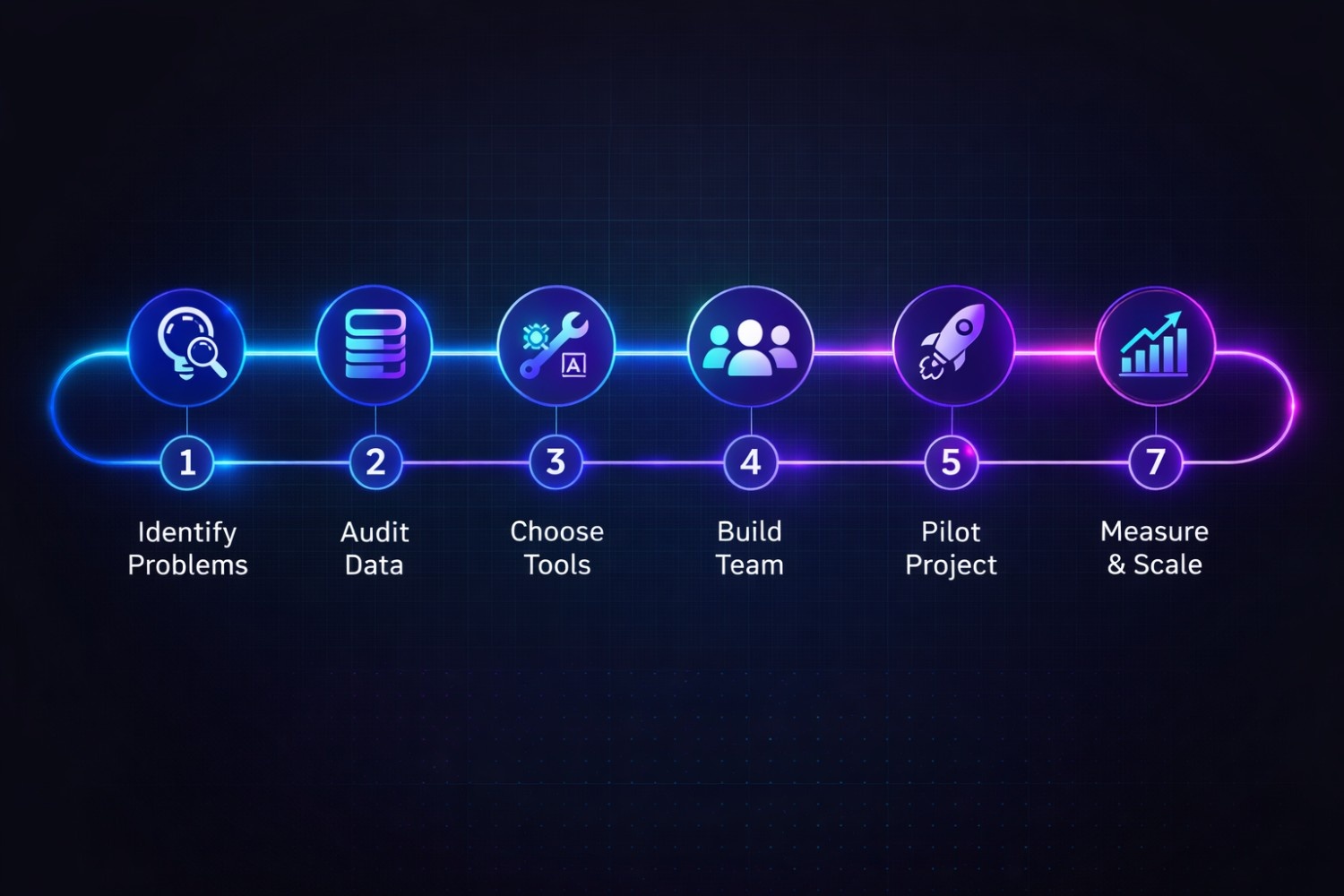
Successfully implementing AI in your business isn't about chasing the latest technology trend—it's about systematically solving business problems with intelligent automation. The seven-step framework outlined in this guide has helped businesses across the United States, United Kingdom, Canada, Germany, and Australia achieve measurable ROI from their AI investments.
Here's your action plan:
- This week: Identify your top 3 business problems that AI can solve using the prioritization framework in Step 1
- This month: Complete a data audit and select your first AI tool—start with ChatGPT for general productivity or a domain-specific solution like HubSpot for sales
- Within 90 days: Launch your pilot project using the 90-Day Framework and measure results
- Within 6 months: Scale successful AI implementations across departments
The companies winning with AI today didn't start by hiring 50 data scientists or building custom models. They started with a single use case, a clear success metric, and the discipline to execute.
Ready to start your AI implementation journey? Explore our best enterprise AI software guide for platform comparisons, read about AI chatbots for business for customer-facing AI, or browse the full ToolNova AI Tools Directory to find the right tools for your team.
Tools Mentioned in This Article
GitHub Copilot
PaidYour AI pair programmer
Copy.ai
FreemiumAI for marketing copy and content
ChatGPT
FreemiumThe AI That Started It All (2026 Edition)
Claude
FreemiumThe ChatGPT Killer? (Anthropic's Best AI)
Jasper
PaidAI Writing for Marketers (But At What Cost?)
Google Gemini
FreemiumGoogle's most capable AI model
AI Fuel Hub Editorial Team
A collective of AI researchers, engineers, and product experts dedicated to testing and reviewing AI tools. Combined 50+ years of experience in artificial intelligence.